Three profiles are posting. Two went quiet in the spring. One still carries a logo you retired two years ago, and a screenshot of last month's reach is sitting in a deck with no date range, no baseline and no note about which network produced it.
That is the normal starting point for a social media audit. Not a blank slate, just a set of numbers with no shared definitions and a suspicion that a healthy-looking profile is invisible to everyone who doesn't already follow it.
Table of Contents
- Social Media Audit Checklist at a Glance
- How to Build a Complete Account Inventory
- Set One Primary KPI and Scoring Rule per Channel
- Check Discovery Eligibility Before Judging Reach
- Measure Performance Without Mixing Metrics
- Match Each Network to Its Real Audience
- Check Sponsored Posts for Disclosure Placement
- Turn Audit Findings Into a Stop, Start or Scale Plan
Social Media Audit Checklist at a Glance
A social media audit breaks the moment it is scoped to a single account. The audience is spread across networks, and each one counts a view, a reach and an engagement under its own rules, so a comparison made from memory is guesswork dressed up as strategy.
The scale explains why. 5.24 billion active social media user identities existed worldwide in February 2025, equal to 63.9% of the global population, and the total rose 4.1% in the 12 months before, according to DataReportal's Digital 2025 global overview. The same research found 97.3% of connected adults used at least one social network or messaging platform each month, and internet users averaged 6.83 platforms monthly. Anyone running four or five accounts is managing a portfolio, not a page.
Work the seven areas below in order. The first three build the foundation, the next four test it, and every row names the data source so two reviewers pull the same evidence.
| Audit area | What to check | Where to pull the data | Pass signal |
|---|---|---|---|
| Account inventory | Every profile, including dormant ones | Network settings and sign-in records | Every account is listed with an owner |
| Owners and access | Who can log in, post and approve | Admin roles on each network | Each account has a named owner and a backup admin |
| Channel objective | One primary KPI per channel | Brand plan and campaign brief | Every account has a stated purpose |
| Distribution eligibility | Whether accounts can be recommended to non-followers | Each network's account status page | No flagged accounts, or each flag has an owner |
| Performance by network | Reach, engagement and follower change over one period | Native analytics export | Results compared on the same date range |
| Audience fit | Where the target audience spends time | Platform usage data and follower demographics | Each network has a clear reason to exist |
| Disclosure compliance | Sponsored posts carry clear labels | Sample of sponsored posts | Every sampled post passes the placement check |
Start at the top. Every later row depends on knowing which accounts exist, and skipping to performance numbers produces a report that describes accounts nobody has claimed.
The reporting step is where audits lose their audience. A PostNitro guide to measuring content results is worth reading before you write the summary, because the same findings land very differently when they're framed as decisions instead of screenshots.
How to Build a Complete Account Inventory
Every later check depends on the list, so build it before judging anything. The inventory is the single record the rest of the audit writes into: owners, flags, KPIs, pause decisions and review dates all attach to a row that has to exist first.
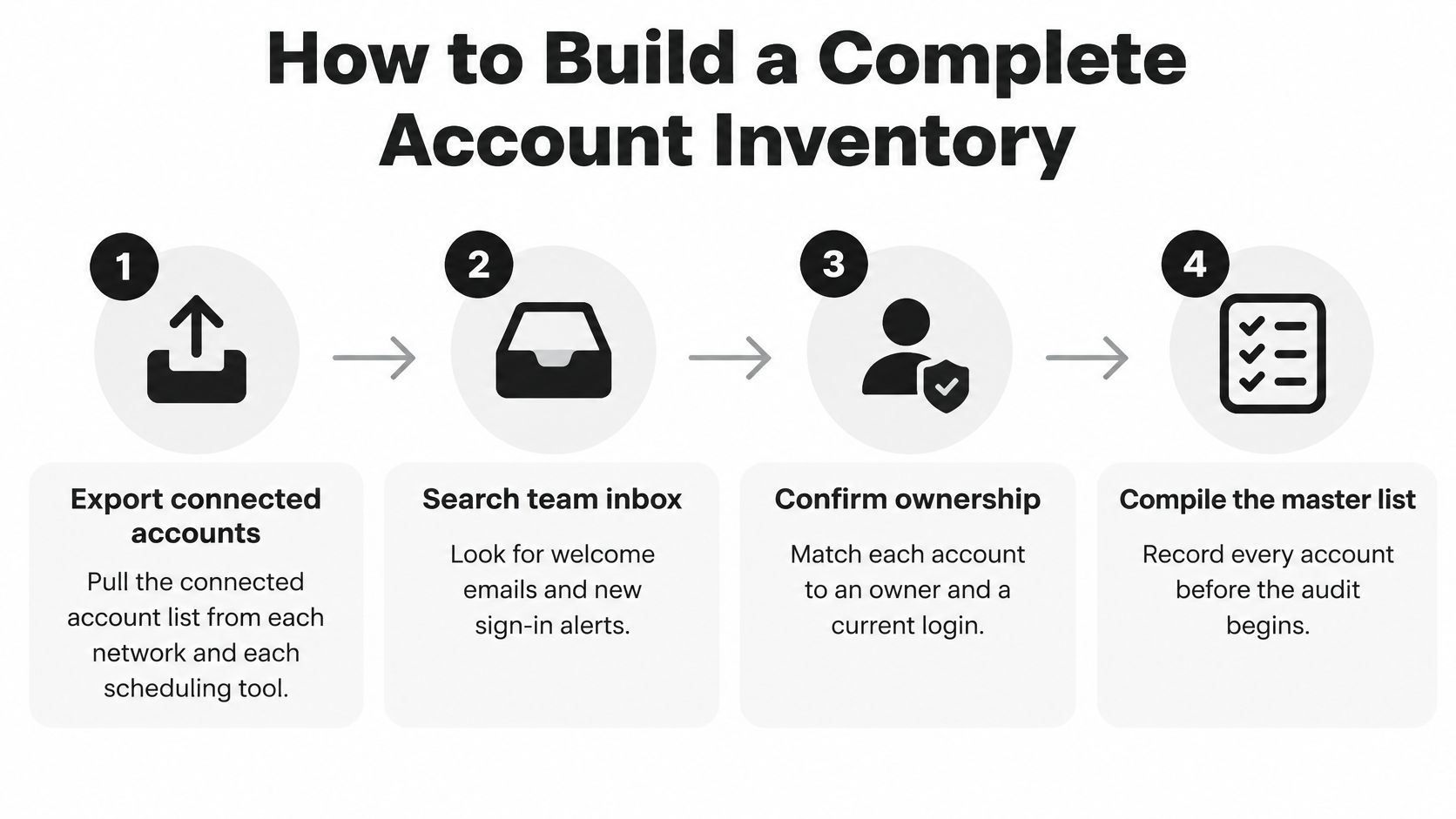
Work through these six steps in one sitting where you can. Splitting an inventory across a week is how duplicates get created.
- Export the lists instead of recalling them. Pull the connected account list from each network's admin settings and from every scheduling tool in use. Tools drift out of sync, and a profile created by a contractor in a hurry often lives in only one of those places.
- Mine the team inbox for breadcrumbs. Search for welcome emails, sign-in alerts and password resets from each network. This is the fastest way to surface the account someone opened for a single campaign and walked away from.
- Fill in the fields that make the sheet usable. Network, handle, brand or client, owner, login method and every person holding admin rights. Give each account a named owner and a backup, because a single admin is a single point of failure when that person takes another job.
- Mark dormant profiles and check what they still touch. Anything with no post in 90 days gets flagged, along with whether it still appears in search or links to a landing page you retired.
- Compare brand details line by line. Bio, link, contact details and logo against the brand sheet. Log every mismatch rather than fixing it on the spot, so the audit records what had drifted.
- Write one purpose line and date the sheet. Sales, support, hiring or community. Save it with today's date so next quarter's pass has a baseline to compare against.
The most common finding is boring and expensive. An old profile still points to a retired landing page, so every click from every post that goes out lands on a dead end. It costs nothing to fix and costs traffic every week it stays.
If those accounts already run through FoPost, the connected account list covers part of step one and shows followers, reach and profile activity per account instead of one blended number. Either way, the sheet is yours to keep, and it belongs in version control rather than someone's desktop.
Set One Primary KPI and Scoring Rule per Channel
Before pulling a single export, give each channel one job and one primary KPI, and write both on the inventory sheet next to the owner. A sales account answers to click-through rate on link posts. A support account answers to response time on comments and direct messages. A community account answers to follower-based engagement rate. Pick two at once and the audit becomes a tournament between numbers that were never competing.
Then lock the rule that turns each checklist area into a verdict. Apply it to every account so two reviewers reach the same score from the same evidence.
Scoring rule: pass means the pass signal is met with no open flag. Watch means the signal is met but the data is partial, older than the audit period, or has moved the wrong way for two periods in a row. Fix means the signal is missing or a flag has no owner.
The middle category does most of the work. Most real audits return a long list of accounts that are technically fine on incomplete data, and burying those under "pass" is how teams talk themselves out of a problem they already suspect.
Judgment matters here, and a wrong KPI is worse than no KPI, because it gets optimized for. If the KPI selection feels arbitrary, the guide to choosing KPIs that match a channel's job is a useful second opinion before you commit the rule to the sheet.
Agencies should agree each client's KPI in writing, since two clients on the same network can reasonably want different outcomes from it. One line is enough, confirmed by the account owner before the audit starts.
Check Discovery Eligibility Before Judging Reach
Follower growth can look healthy while discovery collapses. A profile adds followers steadily, posts consistently, and reach still slides, because the account has lost the surfaces that put public content in front of people who don't follow it yet. That failure rarely shows up in a monthly report, and it gets misdiagnosed as a content problem for months.
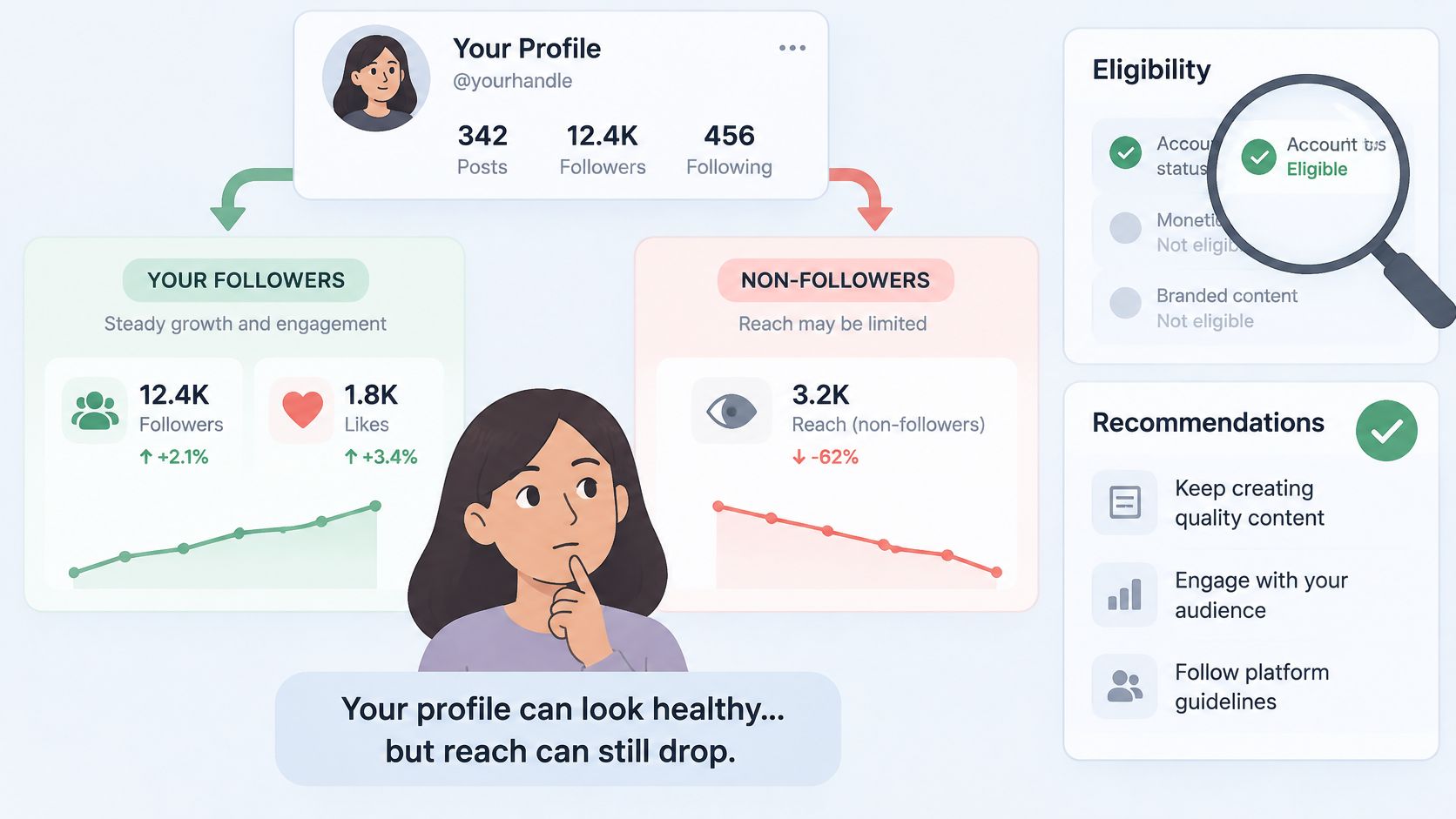
Instagram gives this a direct check. Instagram's account status help page states that professional accounts can check recommendation eligibility in Account Status, and that eligibility determines whether public content may appear in Reels, Feed, Explore, Search or Suggested Accounts for people who do not follow the account. Instagram also says eligibility does not guarantee recommendation, so treat the check as a precondition, not a promise.
If an account isn't eligible, none of its content gets recommended to non-followers, though followers may still see it. That is the exact shape of the problem: the dashboard looks alive to the people already inside.
Run the check as a short routine on every professional account.
- Screenshot Account Status with the date visible. A verdict with no timestamp is useless at the next review.
- Log any flagged profile or post on the inventory sheet with an owner. An unassigned flag is a fix decision nobody made.
- Split reach into follower reach and discovery reach. Without the split, a discovery loss gets blamed on content quality and the team rewrites captions for a month.
- Fix the flagged item, then compare the next 28 days against the 28 before. That window is short enough to read and long enough to escape daily noise.
The distribution question isn't unique to Instagram. A 2025 PNAS Nexus audit of a recommendation system, built on 806 users over two weeks in February 2023, compared a personalized timeline against a reverse-chronological baseline and showed how much visibility ranking alone controls.
Other networks publish their own account standing rules in their help centers. Check each one, and record the page you checked alongside the finding, because these rules change without announcement.
Measure Performance Without Mixing Metrics
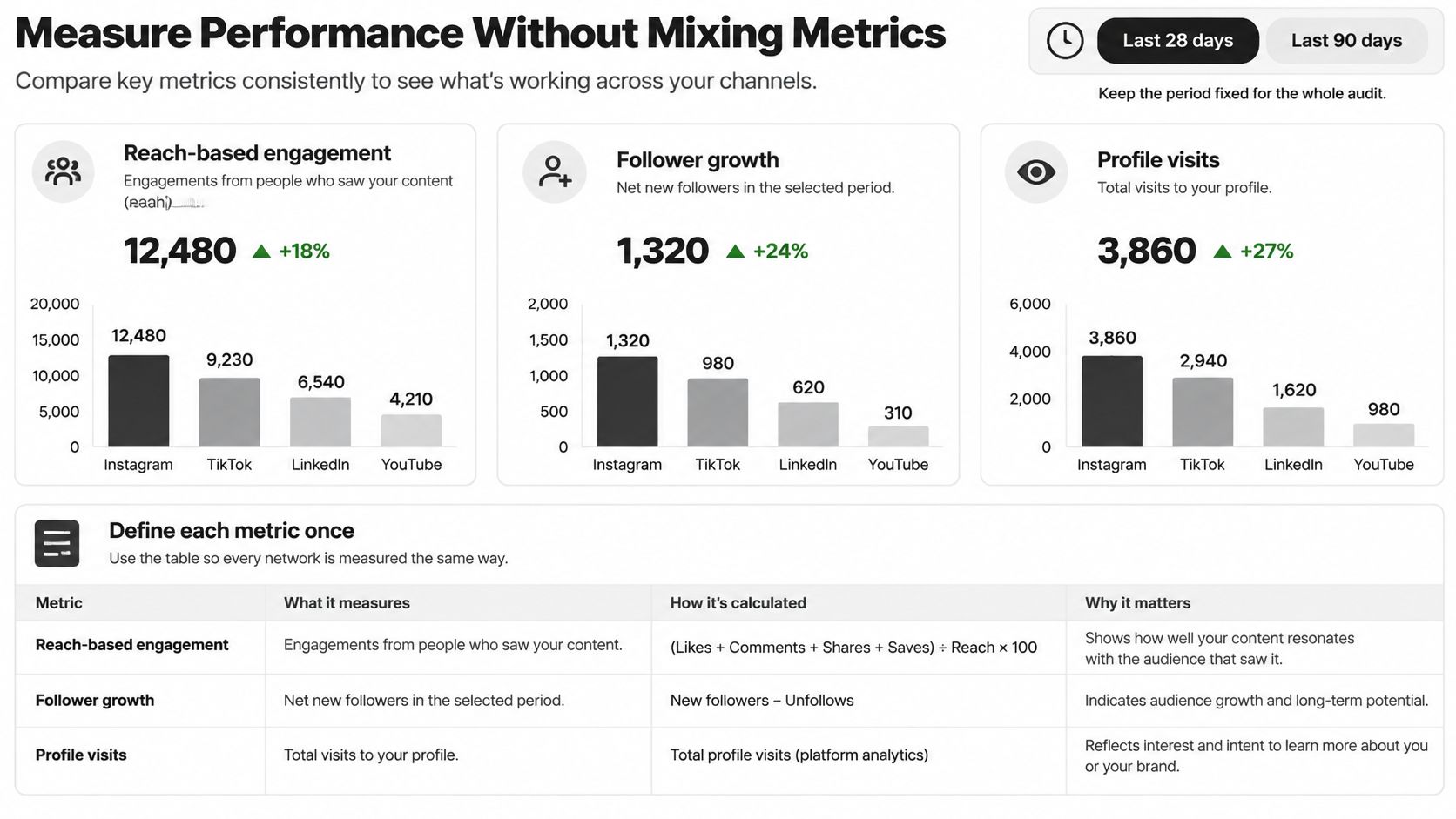
Pick one trailing period, commonly the last 28 or 90 days, and hold it fixed for the entire audit. A dashboard snapshot taken on five different days is not a measurement, it's five measurements, and the differences between them get read as performance.
Define each metric once, before you compare anything, and apply the same definition on every network.
| Metric | Use it to judge |
|---|---|
| Reach-based engagement rate | Content quality per person who saw the post |
| Follower-based engagement rate | How an account performs for its own base |
| Click-through rate | Link posts and calls to action |
| Conversion rate | Fit between the landing page and the offer |
| Cost per acquisition | Paid campaigns only |
Reach-based engagement divides interactions by reach. Follower-based divides by follower count at the time of posting. Those two numbers tell different stories about the same post, and a report that switches between them mid-quarter is unreadable.
Segment before you conclude. Break results by network, format, topic, audience, posting time, and paid versus organic distribution. An account average hides both the winner and the loser inside it, and averages are where most content decisions go wrong.
Do not add metrics from different networks into one score. Reach, views and engagement are counted differently on each platform, so a combined total measures your arithmetic, not your audience.
Compare equivalent cohorts instead. Reels against Reels on Instagram. Short videos against short videos on TikTok. Compare each channel with its own six-month baseline first, then with a market benchmark, and label where that benchmark came from.
A 2025 academic review of social media performance measurement describes the cycle as KPI definition, data collection, reporting and target setting, followed by periodic KPI revision. It flags the pitfall that does the most damage: metric substitution, where follower, like, view and click counts crowd out sentiment and customer value because they're easy to export.
Add two qualitative checks from the inbox before you close the measurement stage. Count the share of comments that are questions or complaints, and count the mentions of a purchase or a sign-up. Those two counts routinely contradict the engagement chart, and when they do, believe the inbox. If you want a second framework for weighing reach against saves, replies and clicks, this breakdown of which content metrics actually matter is worth the read.
Keep the raw native exports. They're the audit record, and they're the only way to answer a question six months later when someone asks how reach was defined.
Match Each Network to Its Real Audience
Start with usage data, not habit. Pew Research Center surveyed 5,022 U.S. adults from February 5 through June 18, 2025, and the spread across networks was wide enough to change where a small team spends its week, according to Pew's 2025 report on Americans' social media use.
| Network | Ever used (U.S. adults) | Daily use |
|---|---|---|
| YouTube | 84% | About half visit daily, 33% several times daily |
| 71% | About half visit daily, 37% several times daily | |
| 50% | Not reported in this survey | |
| TikTok | 37% | Not reported in this survey |
| 32% | Not reported in this survey |
Those figures are U.S.-specific. If your buyers are in Germany, Brazil or Japan, pull local audience data and use the same table shape, because the ranking changes and a strategy built on American usage will point at the wrong network.
Record three things per network on the inventory sheet. Audience fit, active reach and publishing purpose. Then pull whatever follower demographics the network provides, since a mismatch between who follows you and who buys from you is the finding that reshapes a content plan fastest.
Turn usage into a keep, merge or pause decision
- List each network with its primary audience in one line. No adjectives, just who's there.
- Compare that audience with where your buyers, readers or community spend time. Not where they have an account.
- Mark each account keep, merge or pause, with a review date. The date is the part everyone forgets.
Say a B2B team sells to operations managers who mostly live on LinkedIn. Its TikTok account takes several hours a week and reaches almost none of them.
Pause the account rather than deleting it, and write down why. A written reason is a decision you can reverse when the audience shifts. A deleted profile is a decision you can only regret.
When the keep, pause or merge calls are settled, they feed straight into the publishing plan, especially if you're scaling AI-powered organic social campaigns across several networks at once. The guide to building a social media strategy that matches your audience covers how to restructure the calendar around fewer, better-fitted channels.
Check Sponsored Posts for Disclosure Placement
Compliance belongs inside the audit, not in a separate legal review that happens after the campaign. The scope is any post where a brand supplied money, products or a campaign brief, including paid partnerships and creator gifting.
The rule is short. The Federal Trade Commission's disclosure guidance for social media influencers says a material connection, meaning a financial, employment, personal or family relationship with a brand, must be disclosed, and the disclosure should appear with the endorsement itself.
Placement is where most failures happen, and it's tested the way a viewer on a phone would experience it.
- Image or Story. Confirm the label is superimposed on the image and stays on screen long enough to be noticed and read.
- Video. Confirm the label appears in the video, not only in the description below it.
- Wording. Confirm the disclosure is clear and conspicuous, not buried at the end of a hashtag block where the eye stops reading.
- Logging. Record every missing or poorly placed label with the post link, the date and the specific fix, then work the list.
Check every sponsored post in the audit period, or a sample of ten if the volume is high, and record a result for each one. A sample of ten with a documented method is defensible. A spot check with no record isn't.
Fix labels on live posts wherever the platform allows an edit, and add the placement check to the pre-publication list so the next campaign doesn't repeat it. If you're unsure whether a relationship counts as material, ask a lawyer rather than deciding by instinct. Getting the craft right matters too, and this guide to creating content for social media covers how to build disclosure into the format instead of bolting it on afterwards.
Turn Audit Findings Into a Stop, Start or Scale Plan
On Monday, fix the live risk first. If an account is flagged or a disclosure label is missing, address it before drafting another post. Assign each finding an owner and deadline so it does not sit in a spreadsheet until the next audit.
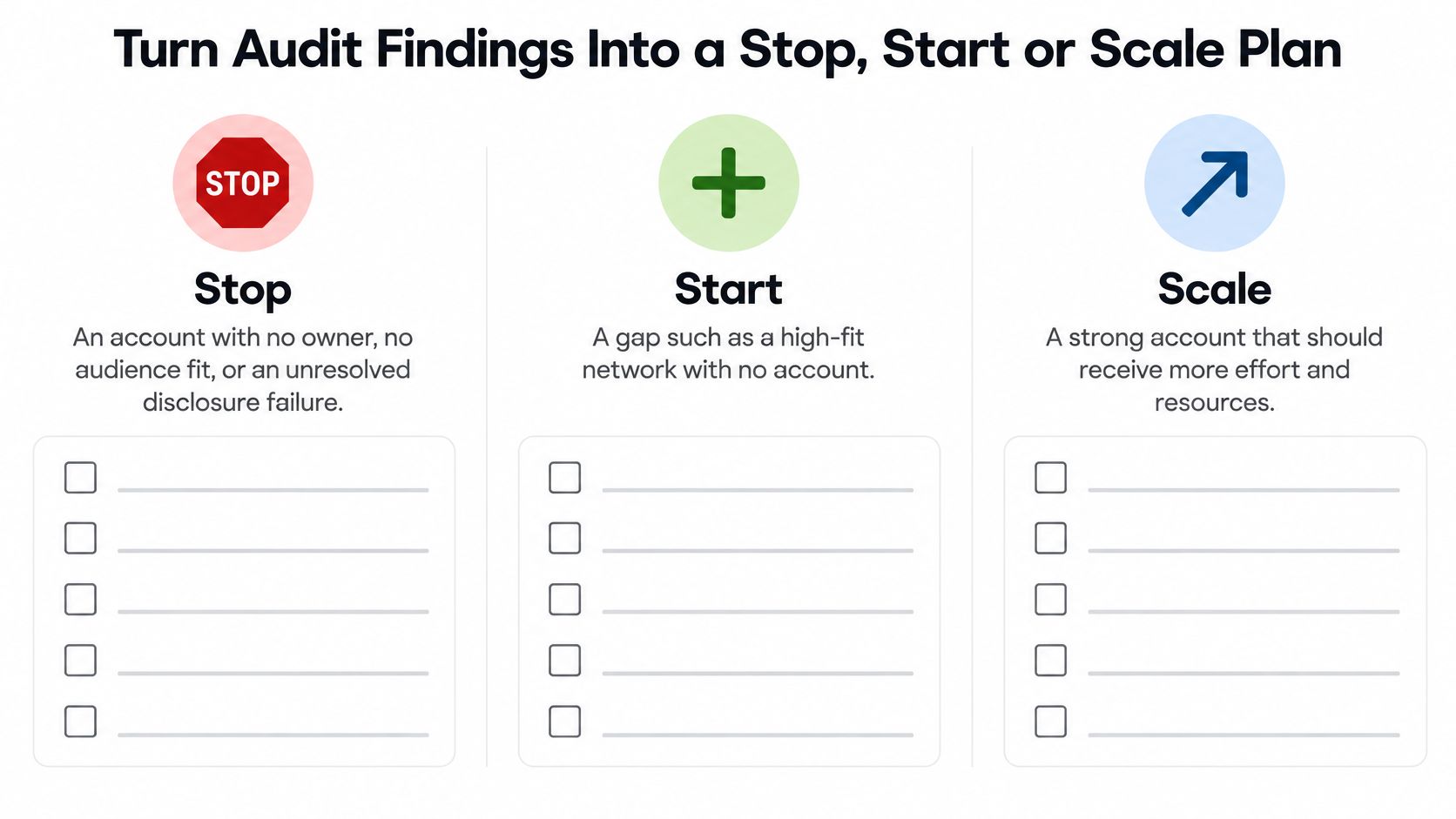
Sort the remaining findings into three buckets.
Stop. Pause an account with no owner, no audience fit, or an unresolved disclosure failure. Record the reason. A pause preserves the option to reconsider; deletion does not.
Start. Address a gap worth closing: a high-fit network with no account, a missing disclosure step in the publishing checklist, or an unresolved discovery flag from the previous review.
Scale. Increase investment in a format or topic that performs well on more than one account. Compare results within each network rather than adding unlike metrics into a single score. A strong result on one account is a reason to investigate, not proof that the approach will work everywhere.
Give each action one owner, one due date, and one measure of success. “The content team” is not an owner. Name the person responsible and specify the result that will show the change worked.
Limit the list to three actions per account. A short list with clear owners is easier to complete and assess than a long backlog.
Set the next audit for 30 days after the first, using the same date range and scoring rules. Reuse the inventory sheet, repeat the checklist, and mark which actions were completed and what changed.
FoPost brings account analytics into one workspace, with reach, engagement, and follower change shown for each account. Connect your accounts to review those results alongside your publishing workflow: FoPost.