A hashtag is a word or phrase after a # symbol that files a post under a topic so people can search and follow it. But if adding more tags guarantees more discovery, why can an untagged post outperform a tagged one?
The answer starts with separating labeling, search indexing, and stream discovery. Those are useful functions, but none promises extra reach. For small teams, creators, and developers managing several accounts, the practical question is which job a tag should perform and how its results can be measured.
Table of Contents
- How Hashtags Sort and Surface Posts
- Hashtag Purposes and When Each One Fits
- How to Choose Hashtags for Each Post
- Hashtag Volume by Network and What the Evidence Shows
- Hashtags Versus Captions and Searchable Language
- Hashtag Mistakes That Hide Results
- Run One Hashtag Test This Week
How Hashtags Sort and Surface Posts
Say a bakery publishes a video about feeding a sourdough starter. Adding #sourdough gives the post a topic label. Someone interested in bread can encounter that label without already knowing the bakery's account.
The mechanics are straightforward. A study of hashtags in threaded discussions explains that placing the # symbol before an uninterrupted word or phrase creates a searchable topic marker. A space breaks the string, so #sourdoughstarter works as a single tag, while #sourdough starter leaves “starter” outside it.
The three jobs behind the symbol
- Labeling: The creator marks what the post belongs to. A starter-feeding demonstration belongs under sourdough, not an unrelated trending subject.
- Search indexing: The platform processes the tagged string so eligible content can appear when someone searches for it.
- Stream discovery: Someone opening the tag can browse related posts, potentially including accounts they don't follow. The exact results and ordering depend on the platform.
The library analogy helps: the hashtag is a catalog card pointing to a book, not the book itself. A correct catalog entry helps someone locate useful material. It doesn't make the material worth reading or ensure the librarian displays it prominently.
The process looks like this:
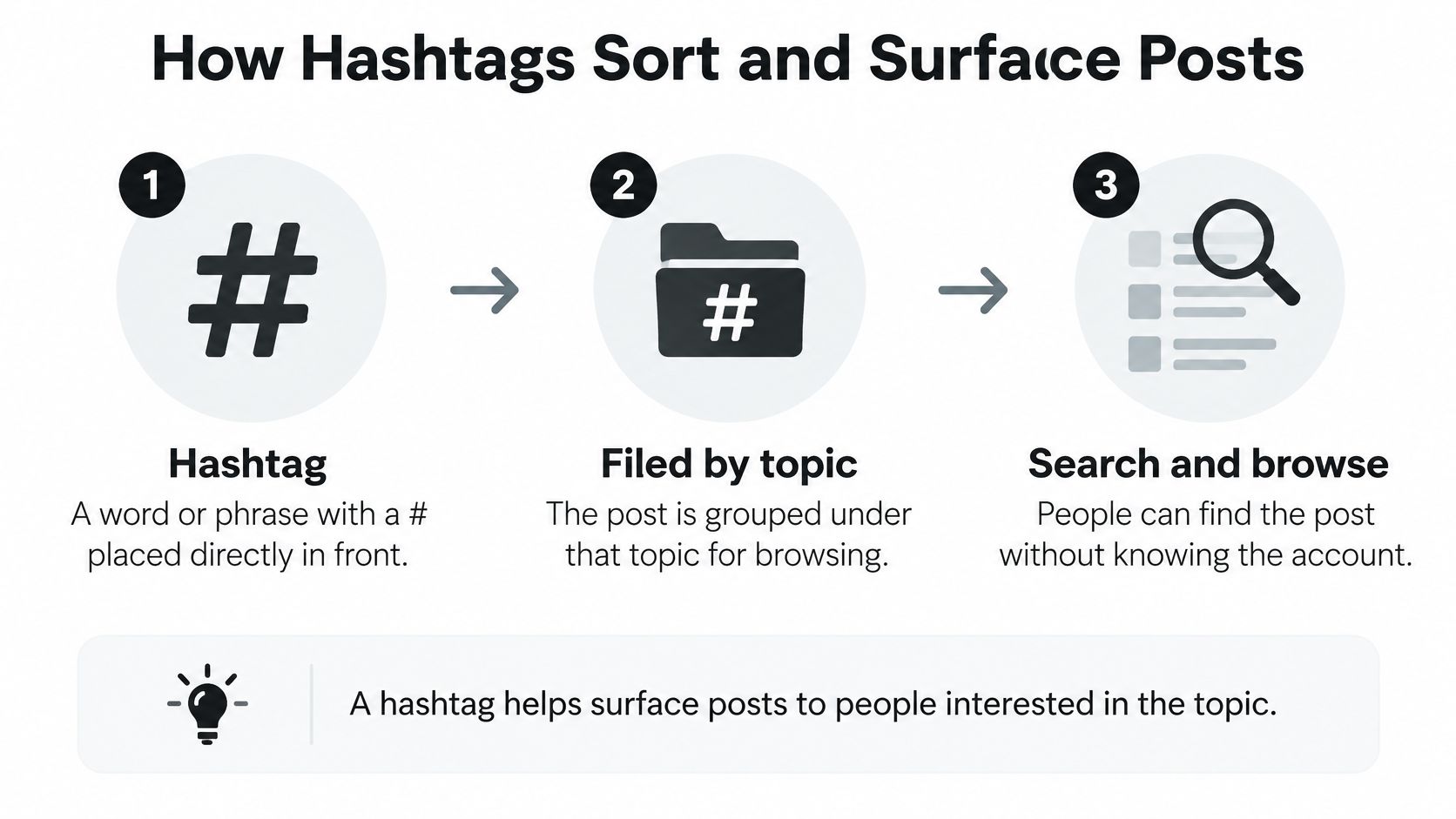
A creator writes the tag, the platform indexes eligible content, and people search or browse and interact. An entry point isn't a distribution guarantee. Public visibility, search availability, and recommendation behavior still depend on the network.
Before publishing: The account manager should search the exact finished tag and inspect what appears, not assume its meaning from its spelling.
For the bakery, that means checking whether the results contain bread-making advice, unrelated promotions, or an unexpected community. A familiar-looking word can still point to the wrong conversation.
Hashtag Purposes and When Each One Fits
How are hashtags used beyond search? People also use them to organize posts, express support, and participate in communities. A six-study investigation of hashtag motivations identified ten motivations, including organizing, bonding, reaching, summarizing, and endorsing, with differences across platforms.
That distinction matters when evaluating success. A campaign tag that neatly collects launch posts may work even without increasing discovery. A community tag should bring relevant participation, not merely place the post beside unrelated content.
Hashtag purposes, examples and how to judge them
These are illustrative tags, not claims that a particular community or event currently uses them.
| Purpose | Example | Best used for | Judge it by |
|---|---|---|---|
| Topic | #sourdough | Content about a subject people search for | Saves and clicks from search |
| Campaign | #HolidaySale2026 | A dated promotion or content series | Clicks and conversions on tagged posts |
| Community | #SmallBizOwners | Joining an existing group conversation | Replies from that community |
| Event | #LocalMakersMeetup | Live or same-week event coverage | Posts published inside the event window |
| Brand | #YourBrandName | Collecting the brand's own posts over time | Growth of tagged posts and their reach |
Each purpose needs its own judging rule. For topic tags, search-related saves and clicks are useful only when the platform exposes that attribution. Otherwise, post-level results are proxies, not proof that a particular tag produced the action.
Campaign measurement needs a destination as well as a label. Tagged links and website conversion tracking can help connect a promotion to visits and purchases. The presence of a campaign hashtag alone doesn't establish that connection.
Participation and organization need different checks
A community tag deserves a qualitative check: are relevant people replying, and do those replies show genuine interest? An event tag needs a timing check. Publishing inside the event window confirms relevance, but audience responses still determine whether the coverage helped.
A brand tag is primarily an organizing device. Creators don't control every public post that uses it, so they should inspect the collection before treating it as a clean brand archive.
Before adapting content for another network, the publishing team should give each planned tag a purpose label. A tag without a clear job is a candidate for removal.
How to Choose Hashtags for Each Post
Selection should begin with the post, not a saved list of popular words. A sourdough starter tutorial needs tags that describe starter care and the people interested in it.
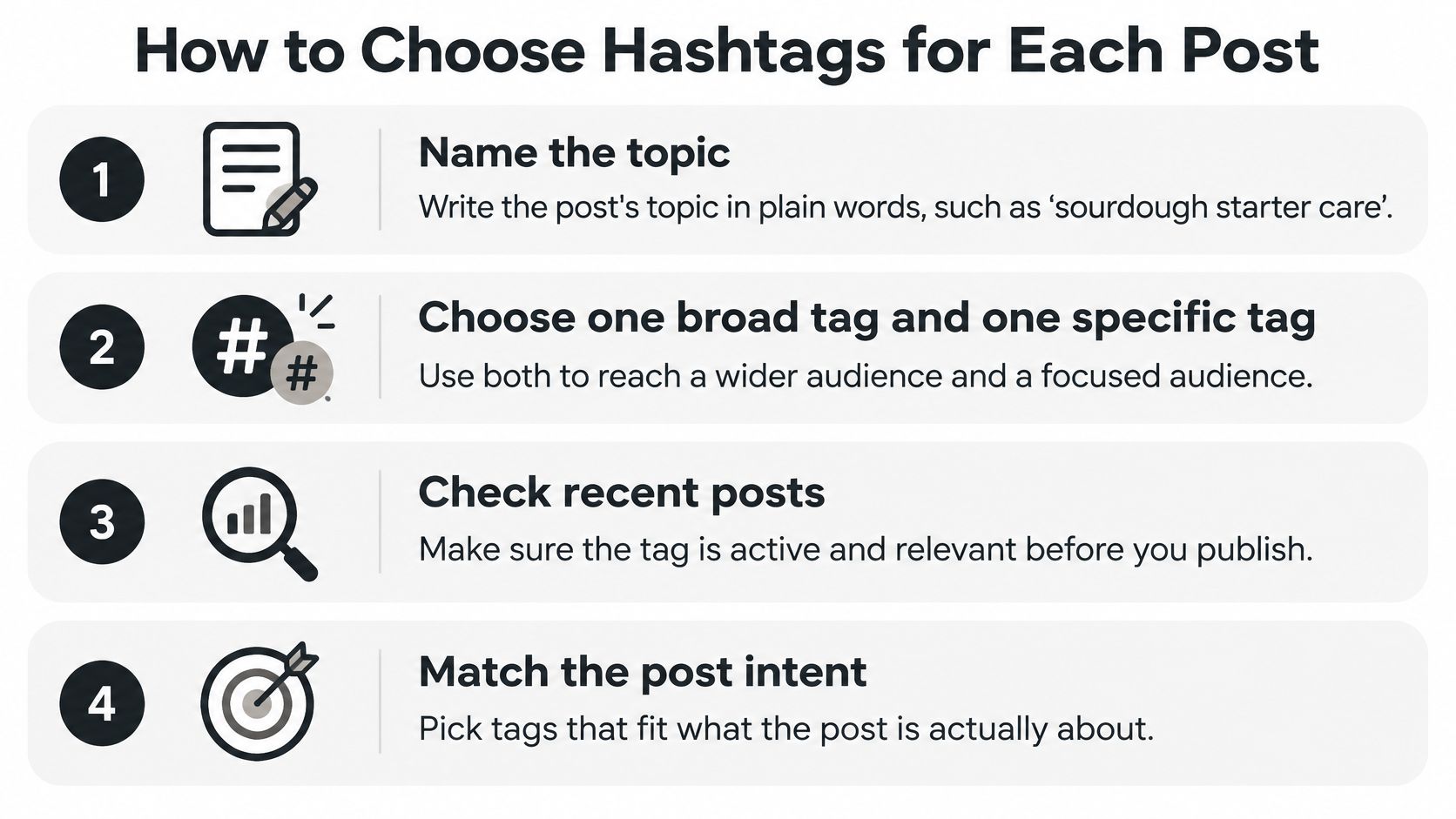
The checklist provides a quick visual reference:
A repeatable selection process
- Name the topic in plain words. “Sourdough starter care” is a useful working description because it identifies what the post teaches.
- Choose a broad tag such as #baking and a specific tag such as #sourdoughstarter. These create different browsing contexts without changing the subject.
- Add an audience tag already used by relevant people. A community label is useful only when the intended community recognizes and uses it.
- Include a campaign or brand tag only when the post belongs in that collection. An unrelated tutorial shouldn't enter a sale campaign merely because the account is running one.
- Search every candidate. The account manager should inspect recent results for relevance, activity, and unintended meanings.
- Keep an initial working set to three to five tags, where platform rules permit. This is a manageable testing baseline, not a proven universal optimum.
Network analysis of photo-sharing hashtags found that tightly integrated core tags were associated with stronger engagement than peripheral tags. The practical lesson is to evaluate coherent clusters, not pile unrelated keywords onto a post.
Tag selection checklist
| Step | Action | Check before publishing |
|---|---|---|
| 1 | Name the post topic in plain words | Topic matches the post body |
| 2 | Pick one broad tag and one specific tag | Both return on-topic, recent posts |
| 3 | Add one community or audience tag | Real people in the niche already use it |
| 4 | Add a campaign or brand tag only when it fits | The tag doesn't collect unrelated posts |
| 5 | Search each tag | No unrelated meaning and no dead results |
| 6 | Keep the set to three to five tags | Each tag has a purpose label |
A hashtag generator can supply candidate phrases, but the account manager still needs to check them inside each network. For campaigns focused on inquiries rather than visibility, Boocoo on hashtags that generate leads offers a useful additional planning resource.
The accompanying video provides another format for reviewing hashtag use:
The final comparison should prioritize unique-user adoption and engagement rate, where available. Counting tags measures publishing activity, not audience value.
Hashtag Volume by Network and What the Evidence Shows
Published Instagram findings conflict. Later's overview of hashtag volume describes an analysis of 18.1 million feed posts with the highest average reach and engagement around 20 to 30 hashtags, alongside a 2025 analysis of more than 45,700 profiles and 4.4 million posts in which posts without hashtags reached 23% more people.
That same overview describes a separate study of positive hashtags and perceptions of the poster. More favorable impressions of someone's personality aren't evidence of greater distribution. Reach, audience perception, engagement, and conversion are different outcomes.
Published hashtag findings by network and how to test them
The Instagram rows summarize the analyses described above. The other starting counts are proposed experiments, not established platform optima.
| Network | Published finding | Starting test | Track |
|---|---|---|---|
| Highest average reach and engagement around 20 to 30 hashtags in an analysis of 18.1 million feed posts | Compare 3 to 5 tags against 20 to 30 on similar posts, only where current limits permit | Reach, saves, profile visits | |
| Posts without hashtags reached 23% more people in a 2025 analysis of 4.4 million posts | Add a no-hashtag control alongside a tagged post | Reach against the control | |
| TikTok | Hashtag search provides an entry point; viewer interactions inform recommendations | Use one focused tag describing the video | Search views, follows, saves |
| Optimal count unknown from the evidence considered here | Test one to three topic tags | Reach, qualified comments, clicks | |
| X | Optimal count unknown from the evidence considered here | Test one to two tags | Impressions, replies, link clicks |
TikTok's explanation of discovery describes hashtag search alongside videos, creators, and sounds, and explains how interactions inform later recommendations. A focused tag therefore provides a sensible test, not a promise of feed placement.
A historical association isn't a current publishing rule. Platform limits take priority over an experimental tag count.
Keep organic and paid results separate
Comparable variants should use similar creative, topics, audiences, and publishing windows. The working baseline can remain a small, purpose-labeled set, with a larger historical range treated only as a separate experimental arm when permitted.
Reach, saves, clicks, comments, and follower changes should be reported separately. An Instagram growth strategy also needs to account for the content and profile experience, not just tags.
Teams running ads alongside organic posts should separate those results. Guidance on paid social scaling for e-commerce brands addresses a different distribution mechanism, so paid reach shouldn't be credited to an organic hashtag test.
Hashtags Versus Captions and Searchable Language
Hashtags are one discovery signal, not a replacement for descriptive captions. Plain language deserves priority because it tells a person what the post offers before any topic stream or campaign label becomes relevant.
Content Marketing Institute's hashtag strategy coverage reports that Instagram removed hashtag following in late 2024 and that its leadership said hashtags no longer meaningfully drive reach; it also cites a 2025 Sprout Social survey in which 52% of social-media users relied on social platforms to find user-generated content and personal experiences. That supports continued attention to discovery, but doesn't establish that most searches use hashtags.
Write the searchable sentence first
For a starter-care tutorial, the caption could begin: Sourdough starter care for a cold kitchen. That sentence names both the subject and the situation. A vague opening followed by a block of tags gives readers less help.
A practical division of labor is:
- Caption language explains the answer. It should include the phrase a person would naturally use to describe the problem.
- A topic tag adds a browsing label. It should accurately categorize the content rather than introduce a different subject.
- A campaign or event tag identifies membership. It connects the post to a named collection that ordinary prose may not identify consistently.
For background on meaning versus literal word matching, Zemith's SEO guide for content creators provides a useful conceptual resource. It shouldn't be treated as documentation of a particular social platform's ranking system.
A caption-led post and a caption-plus-tags version can be compared during a similar publishing window. Saves and profile visits provide useful outcomes, but neither should be attributed to tags unless the platform supplies that attribution.
Hashtag Mistakes That Hide Results
A busy tag can produce impressive-looking exposure without attracting the intended audience. The mistake is treating that exposure as proof of useful discovery.
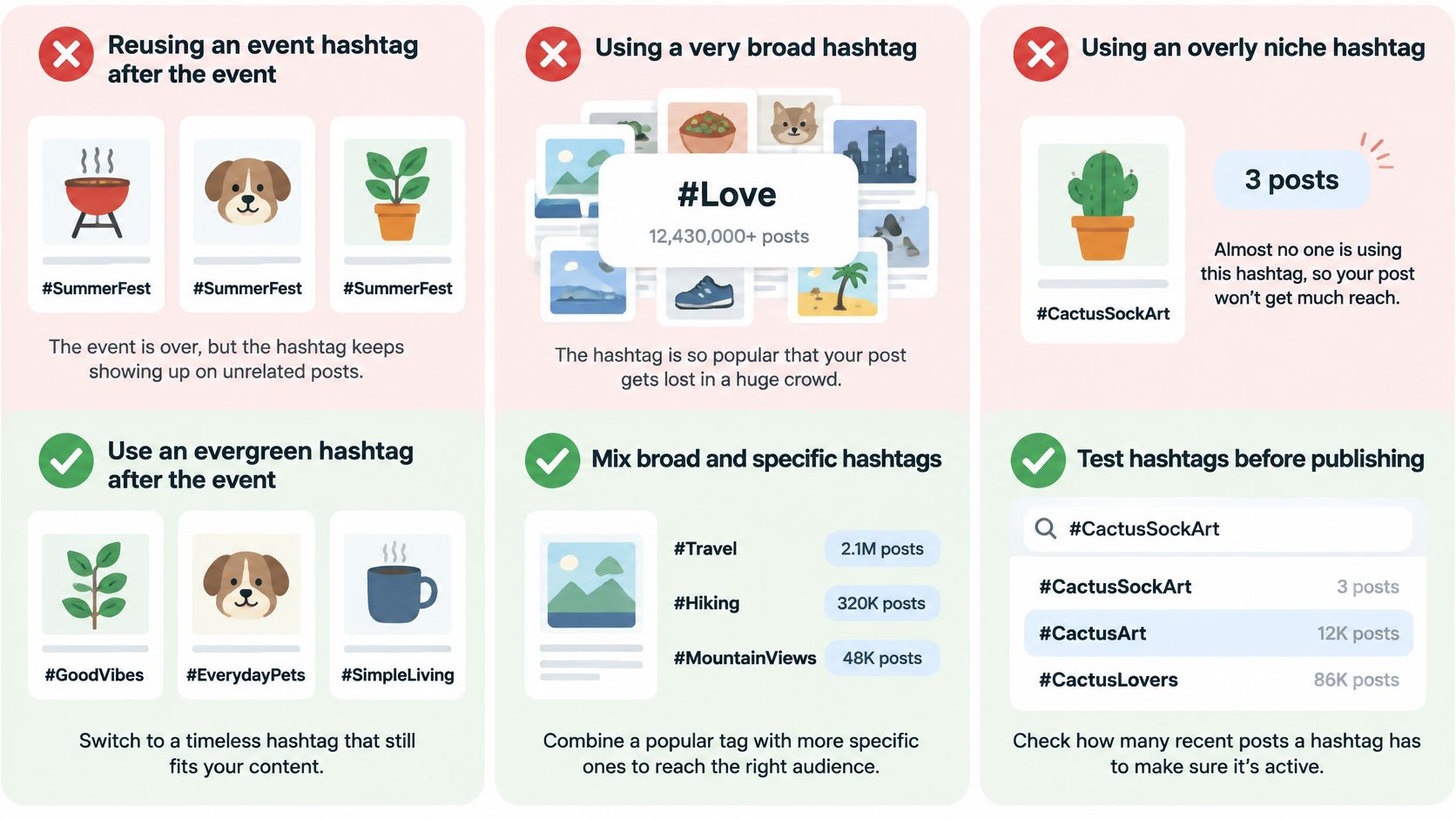
These checks distinguish visibility from relevance:
Stale events and mismatched audiences
- Reusing last month's event tag: Public tags can continue collecting posts after an event closes. The publisher should retire the event set, then inspect the current stream before reusing any part of it.
- Borrowing an unrelated trending tag: The account manager should read the first ten results as a practical spot-check. If the topics and participating accounts don't resemble the intended audience, high activity isn't a reason to join.
- Skipping language and market checks: The exact string should be checked in every publishing market. A native speaker can help identify unintended meanings, awkward word boundaries, or local associations.
Diagnose the mismatch
A concerning pattern is rising views alongside weaker saves, clicks, or relevant replies. That pattern doesn't prove the tag caused the problem, but it warrants checking who encountered the post and what they expected.
A tag deserves retention because it serves its assigned purpose, not because its results page looks busy.
The fix isn't automatically fewer tags. It's a better match between the post, the people expected to read it, and the action that would make the post useful.
Run One Hashtag Test This Week
Today's action is simple: an account manager should choose an upcoming post on a single network, assign a purpose to each planned tag, and prepare a version without hashtags. The creative and caption should remain as similar as practical.
The metric needs a definition before collection begins. A methods study on Instagram hashtag access describes differences between the former Platform API's capabilities and Graph API searches for popular or recent tagged content. A search result sample mustn't be presented as a complete historical total.
Record what was actually measured
- Platform and account: Keep results from different networks distinguishable.
- Exact query: Preserve the tag string, including spelling.
- Retrieval date: Record when the search or measurement occurred.
- Result type: Distinguish recent tagged posts, posts returned by a search, and lifetime totals.
- Outcome definition: Specify whether a click means a post interaction, an outbound visit, or another platform-provided measure.
For teams defining a shared scorecard, a social media KPI guide can help distinguish activity measures from business outcomes. Unsupported metrics should remain unavailable rather than being estimated from unrelated counts.
Schedule and review the comparison
FoPost can schedule the tagged post and control during the same week, while its API and SDKs let developers connect publishing and reporting workflows. Posts can carry campaign or deliverable labels, views can be filtered by those labels, and analytics include engagement, followers, top posts, and campaign roll-ups. Those internal labels aren't public hashtags.
After a week, the team should compare reach, saves, and clicks, where the network provides them. Timing within the same week doesn't eliminate differences in audience exposure, and sequential posts aren't a randomized experiment.
A reach difference alone can't establish causation. The team should record the result, retain the useful tag-purpose combinations provisionally, and repeat the comparison before making a standing rule.
FoPost offers scheduling and publishing across major networks from one workspace, plus free tools including a Hashtag Generator, UTM Generator, Character Counter, and Photo Resizer. Visit FoPost to prepare a focused tag set and schedule a tagged post alongside a no-hashtag control for the next publishing week.