You have six tabs open. There's a caption half written for Instagram, a longer version sitting in a scheduler for LinkedIn, and a draft for X that ran out of characters twice. Someone on the team asks which one is the final post.
The answer isn't the one most style guides give. Each network gets its own version on purpose, not the same sentence trimmed to fit a limit but the same claim written for the people who read that feed and for the reason they're there.
Five principles do most of the work: audience fit, platform tone and length, clarity paired with a deliberate emotional tone, one specific call to action, and honest disclosure. Put them in that order and the tab count stops feeling like a problem.
Table of Contents
- Social Media Copywriting Explained in Plain Terms
- Start With the Reader Before the Platform
- Match Tone and Length to Each Network
- Write Clearly and Choose the Right Emotional Tone
- Write Calls to Action That Get a Specific Response
- Use AI Drafts Without Losing Your Voice
- Disclose Sponsored Posts and Verify Every Claim
- Run Every Post Through a Pre-Publish Check
Social Media Copywriting Explained in Plain Terms
A launch post goes live at 9:03. By 9:20 the X version has replies from engineers, the Instagram caption has saves from shop owners, and the LinkedIn paragraph is being quoted by a partner. Same announcement, three reactions, because each version was written for the feed it entered.
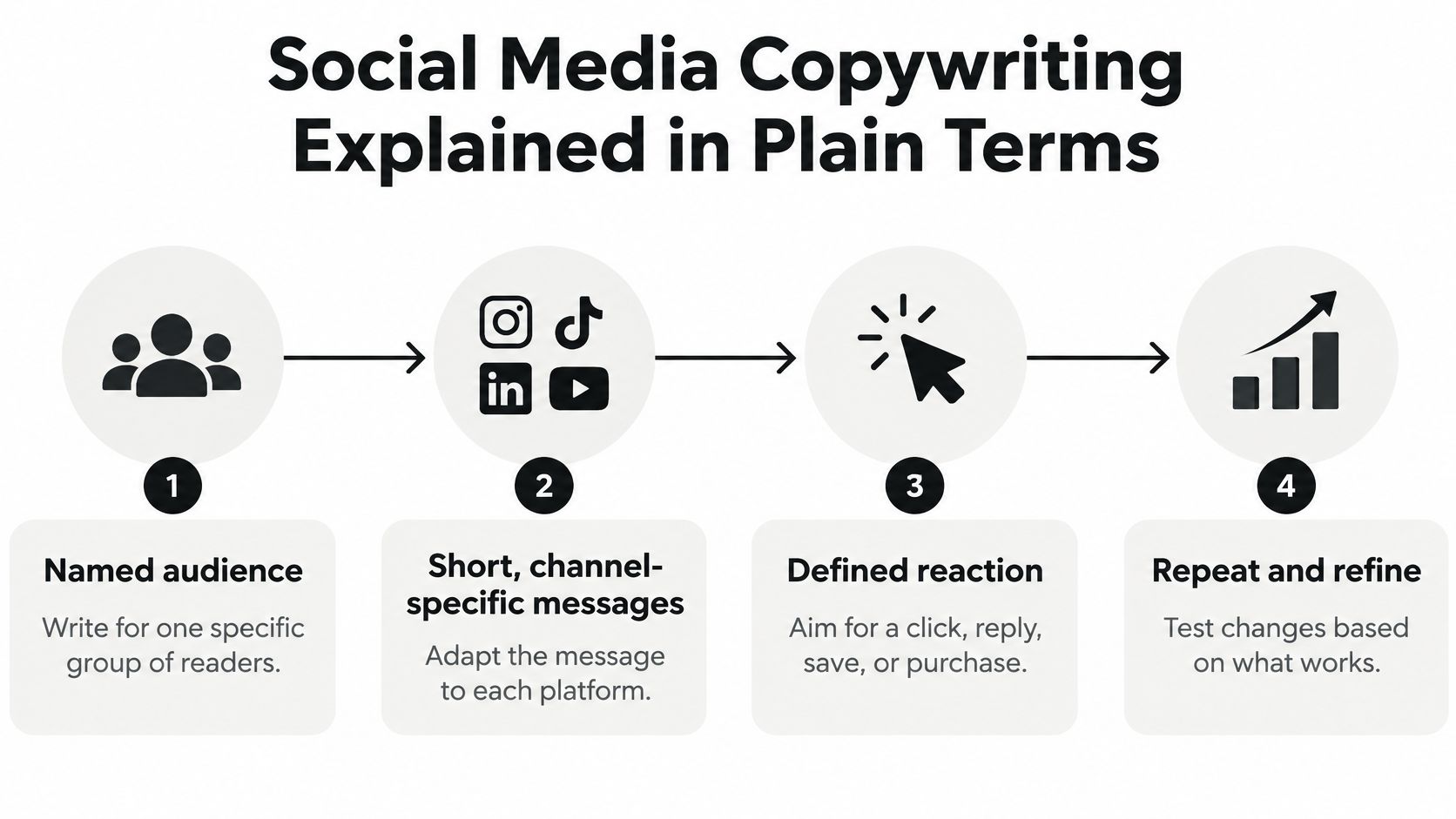
Social media copywriting is writing short, channel-specific messages that earn a defined reaction from a named audience, then repeating the process with changes based on what happens.
A stage speech and a dinner-table conversation can share a goal without sharing a script. The speech assumes quiet until you finish. A conversation survives on interruptions, corrections, and reactions nobody planned for. Social copy is the dinner table, and the audience leaves the moment it gets bored.
That is why copywriting social media posts means more than trimming a brochure to caption length. Attention is shorter, reaction is visible, and correction is public. Five principles carry the craft whether the account belongs to a solo newsletter or a twelve-brand agency roster.
Pew Research Center's decade-long study of social networking adoption reports that 7% of U.S. adults used social networking sites in 2005 and 65% did by 2015. Copy moved from fixed pages to a stream of short messages aimed at segmented audiences, with a reaction attached to every post.
Five principles carry everything else in this craft.
- Audience fit. One named reader per account, rather than a demographic cloud.
- Platform tone and length. The objective stays, the wording changes.
- Clear wording with a deliberate emotional tone. Plain sentences first, then a chosen feeling.
- One specific call to action. A single next step, worded for the reaction you want.
- Honest disclosure. Every claim verified, every paid relationship labeled.
Treat each network as a separate decision. Tone changes the kind of reply you get, emotional wording changes saves and shares, and disclosure changes whether people trust the next post. Those reactions are the feedback loop.
When a product launch has to run across several channels at once, BEDHEAD's mattress social media playbook shows how one brand voice gets split into different post types without repeating the same caption everywhere.
Run any draft through one line of questioning before it reaches the scheduler: who is it for, what does it do on this network, is it clear, what should the reader do next, and is every claim and label honest. A draft that fails any part of that is not ready, and no amount of hashtag research will rescue it.
Start With the Reader Before the Platform
The platform sets the format. The reader sets everything else, and reversing that order is the most common reason a well-written post flops.
Say a software team ships an update that changes how failed webhooks retry. On X, the post names the change and the version number in one line, no preamble, because the people following that account already know what a webhook is and want the fact. On Instagram, where shop owners follow the same company for different reasons, the post leads with what they get: fewer missed orders when a payment stalls. Same launch, same link, two different first sentences.
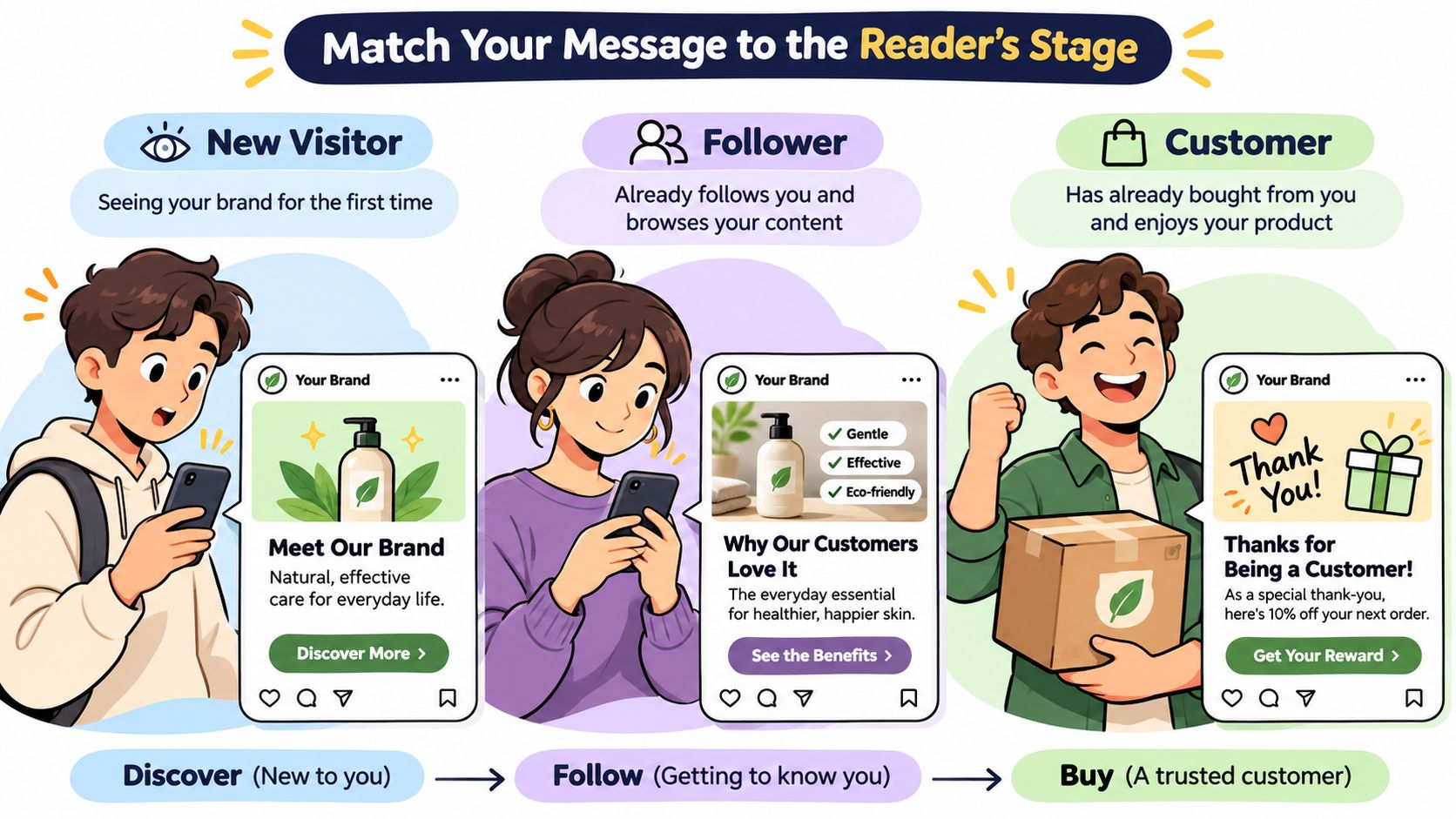
The differences track how close each reader stands to the account. Someone who has never heard of the brand needs context and a reason to care. A follower needs a reason to act today. A customer needs confirmation that the thing they already bought still works.
The other half of audience fit is what the reader is doing in the app at that moment. Scrolling between friends' updates is a different state of mind from searching for a fix to a broken checkout, and both are different from comparing three vendors side by side before a purchase.
The four-question audience brief
Fill this in once per account and keep it where the team can find it.
- Who is the reader? A job title, a situation, a level of experience. "Shopify store owners doing their own marketing" beats "SMBs."
- What do they already know? Whether they know the product name, the problem it solves, or neither.
- What do they want from this post? A fix, a comparison, a laugh, a discount, a reason to trust the account.
- What would make them stop scrolling? The specific detail, number, or phrasing that interrupts the pattern of their feed.
If the account doesn't have a written strategy behind it yet, work through building a social media strategy before rewriting captions, because the brief depends on decisions that live above the post level.
The failure mode to avoid is writing for everyone. A post aimed at the whole market reads as relevant to nobody, and the fix isn't more adjectives. It's a narrower reader.
Keep the brief in a shared document, attach it to each account inside the scheduler, and read it before every draft gets approved. The five minutes that takes is cheaper than a week of posts that miss.
Match Tone and Length to Each Network
Reach figures tell you where people are. They don't tell you how they read, and that's the part that changes the wording.
The Pew Research Center's 2023 survey of 5,733 U.S. adults found that 83% reported ever using YouTube, 68% used Facebook, and 47% used Instagram. TikTok reached 33%, up 12 percentage points from 21% in 2021, while LinkedIn, WhatsApp, Pinterest, and Snapchat each sat in the 27% to 35% range. X and Reddit each drew about one in five adults.
| Network | U.S. adult reach (2023) | Tone and length that fit |
|---|---|---|
| YouTube | 83% | Searchable title and a clear premise in the first line |
| 68% | Plain, conversational, community-focused | |
| 47% | Concise caption that adds context to the visual | |
| TikTok | 33% | Fast hook in the opening seconds, casual |
| 27% to 35% range | Professional, specific, lesson-led | |
| X | About 1 in 5 | Short and direct, one idea per post |
What the numbers change about the first line
The table gives you a default, not a script. The practical work is in the opening line, because most feeds collapse long captions after two or three lines and every network collapses them at a different point.
On YouTube, write the title the way a person would search for the answer, then make the opening premise of the video obvious in the first sentence of the description. On Instagram, the caption should say something the image can't, because the visual already carries the what. On LinkedIn, a specific lesson with a concrete outcome gives readers a reason to keep going, and vague inspiration gives them a reason to scroll past. On X, one idea per post, stated plainly, outperforms a thread opener that withholds the point.
Length guidance stays qualitative on purpose. Keep the Instagram caption short enough to land before the "more" cut. Let the YouTube description carry detail, timestamps, and links. Hold X to a single idea. Caption limits are set by each network and change without much notice, so check the current limit in each network's help pages before a campaign that depends on it.
For a closer look at why adapted posts behave differently from identical ones, the guide on platform-native publishing instead of copy-paste walks through the mechanics.
The same adaptation logic shows up anywhere a single offer has to work in different feeds. Writers producing captions that sell gym memberships start from the same offer and end with noticeably different wording, because a casual caption that earns a comment is doing a different job than a sales line that earns a click.
One master message, several versions
Write the master message first. It holds the core claim and the offer, in plain language, with no platform in mind.
Then adapt three things for each network: the opening line, the length, and the vocabulary. Leave the offer identical across every version. If the discount says 20% on one network and "a special deal" on another, the results can't be compared and the team learns nothing from the week.
Write Clearly and Choose the Right Emotional Tone
Clarity comes before personality. A caption nobody finishes can't persuade anyone, and a muddled first line makes every later choice harder to measure.
- Lead with the subject and the verb. "We rebuilt the export tool" beats "An update has been made to our export functionality."
- Cut the filler. "In order to," "basically," "what we're trying to say," and "it's important to note" all delete cleanly.
- Keep one idea per post. Two ideas split attention and split the metric you're trying to read.
- Define the jargon once. If the reader needs a term to understand the offer, explain it in five words rather than assuming.
- Read the draft aloud. Sentences that run out of breath on the way to the verb need cutting.
Emotion is a variable, not a volume knob
Emotion works as a set of choices: positive or negative, warm or urgent, specific or broad. Each choice can move a different reaction, so the useful question is which reaction the post was built to earn.
A large-scale study of 15,396 brand posts from 104 Facebook pages across 18 industries found that linguistic style affects engagement, but unevenly. Emotionality, complexity, and informality produced different effects for likes, shares, and comments, which means a team should stop treating "engagement" as one number and start asking whether the post was meant to be liked, discussed, passed along, or clicked.
Valence matters just as much. Research on 5,997 Facebook posts from 42 brands found that positive emotionality was associated with more likes (γ = 0.40, p < .05), while negative emotional words were associated with fewer likes.
Both results are observational and Facebook-specific. They generate hypotheses worth testing, not promises about next month's numbers.
Practical rule: warm and specific for reaction-style posts, neutral and information-dense for posts built to be shared, and hold fear, anger, or loss framing for experiments where urgency is the actual point.
How to run the test
Build two versions with the same offer, the same length, and the same image, and change only the emotional valence. Schedule them at similar times of day on comparable days. Then compare likes, comments, shares, and clicks separately before choosing a house tone.
Read the pattern by reaction, not by total. A version that wins likes but loses comments may be pleasant without giving anyone a reason to answer. A version that earns shares with fewer likes may be useful enough to pass along. That difference is what keeps tone decisions tied to outcomes instead of taste.
If developer posts on your accounts keep underperforming, the problem is often the opening line rather than the emotion. The patterns in posts developers don't scroll past break down openings worth copying.
Write Calls to Action That Get a Specific Response
Every post carries one primary call to action. One, not three, and it should match the reaction the post was built for.
A question that asks for a comment, a promise that earns a save, a link that earns a click, a keyword that triggers a message, and a prompt that earns a share all need different wording. Recycling one ask across all five goals is how teams end up with posts that get likes and nothing else.
| Goal | CTA pattern | Example copy |
|---|---|---|
| Comments | Ask one specific question | Which step takes your team the longest? |
| Saves | Promise a reusable asset | Save this checklist for your next product launch. |
| Clicks | Name the destination and what the reader gets | Get the five-step setup guide at the link in bio. |
| DM replies | Give one keyword to send | Comment SETUP and we will send you the template. |
| Shares | Name the person who should see it | Send this to whoever runs your social calendar. |
Why specific beats generic
"Get the five-step template at the link in bio" tells the reader what they receive, so they can decide whether it's worth a tap. "Link in bio" gives them nothing to weigh, and a reader with nothing to weigh usually keeps scrolling. The same gap separates "Comment with your setup and we'll answer" from "Let us know your thoughts."
Specific asks also make results readable. If the wording names the asset, a spike in clicks tells you the asset was the draw. If the wording is vague, a spike tells you almost nothing and next week starts from zero.
Where the ask goes
Put a comment prompt near the end of the caption, after the substance, where a reader who finished the post will meet it. Put a click prompt above the hashtag block, not inside it, because a line buried in a string of tags gets skipped by the same readers who skip the tags. On short video, say the ask out loud and put it on screen, since plenty of viewers watch with sound off.
Three asks in one post splits attention three ways and makes the results impossible to attribute. If a campaign needs a comment and a click, split it into two posts and measure them separately.
Track each call to action on its own line in your reporting sheet. Then you can see which wording moved which goal, instead of staring at a combined engagement figure that hides the answer.
Use AI Drafts Without Losing Your Voice
AI makes drafts fast, and fast drafts tend to read like every other fast draft. That is the tradeoff worth managing, network by network, rather than ignoring.
Recent experimental research covered in Nature's report on AI-assisted content and perceived authenticity found that AI interventions can raise the volume of generated content while lowering perceived discussion quality and authenticity. Participants described the AI text as robotic, generic, or impersonal. Audiences report a similar gap elsewhere: people tend to trust search results and user reviews more than AI-generated content.
None of that argues against using the tools. It argues against publishing the first draft.
A human-in-the-loop protocol
Run every AI-assisted draft through the same five steps.
- Generate the draft. Use one prompt, one platform, and one audience. A LinkedIn version and a TikTok version are two separate jobs, because the tone that reads as confident on one reads as stiff on the other.
- Add a firsthand detail. A customer phrase, a number from your own dashboard, a thing that happened this week. Specificity is the cheapest authenticity signal available.
- Check it against past posts. Read the draft beside two posts that performed well on that account. If the rhythm or vocabulary drifted, edit until it matches.
- Mark what must never be automated. Stories, performance claims, apologies, and anything about a person's money or safety stay hand-written.
- Disclose where the audience would expect it. If the account's readers would feel misled by unlabeled AI copy, label it.
The payoff comes after approval, when one signed-off draft gets reshaped into several network versions. The tool handles the restructuring. The editor still owns the claim, the story, and the tone, and the reaction on each network, measured in comments, saves, and clicks, tells you whether the voice survived the resize.
The teams that get this right use AI for structure and variation, and keep humans on evidence and voice.
Drafting is only part of the shift. How AI reshapes social discovery looks at what changes when platforms themselves start generating and ranking content, which affects how much weight a single caption still carries.
Disclose Sponsored Posts and Verify Every Claim
When a material connection could affect how someone judges a recommendation, that connection has to be disclosed alongside the endorsement itself, not somewhere a reader might not connect to the claim.
The wording rule is plain: use "Ad," "Sponsored," or "Paid partnership with [Brand]" near the claim. The FTC's guidance for brands and influencers on clear disclosure notes that many consumers may not understand abbreviations such as "#sp," "Thanks [Brand]," or "#partner" to mean a post is sponsored, and it warned that a disclosure placed below the "more" button on Instagram can fail at the exact point where users first see the endorsement.
Placement changes by format. The FTC's disclosures guidance for social media influencers says that for Instagram Stories, Snapchat, and similar image-based posts, the disclosure should sit over the image and stay visible long enough to notice and read. A hashtag such as #ad or #sponsored is acceptable but not required, and disclosures buried after long strings of hashtags, tags, or links may not be conspicuous because readers skip past them.
Video needs its own check. The FTC's guides concerning endorsements and testimonials describe a disclosure as clear and conspicuous when factors like size, contrast, location, and duration work together, and note that presenting it visually and audibly at the same time is more likely to land. Review the first frame or overlay on short video, and check readable contrast before publishing.
The claim check that comes before the label
A label doesn't fix a bad claim. The FTC's truth in advertising guidance on endorsements is direct: a post that recommends a product must reflect the endorser's honest opinion or experience, and nobody should describe using a product they haven't tried or make claims requiring evidence the advertiser doesn't hold.
So separate the two kinds of sentence in every sponsored draft. Personal experience is defensible when it's real. Performance statements like "reduces costs," "works in 30 days," or "best on the market" need a source the team can produce on request.
Two-person rule: the writer confirms each claim exists, the reviewer checks the evidence behind it, and the post states any paid relationship in plain words.
That sequence takes about as long as reading the caption twice, and it prevents the failure that no apology post recovers from.
Run Every Post Through a Pre-Publish Check
A checklist is worth more than a style guide because it gets used under deadline. Here is one that takes about five minutes per post.
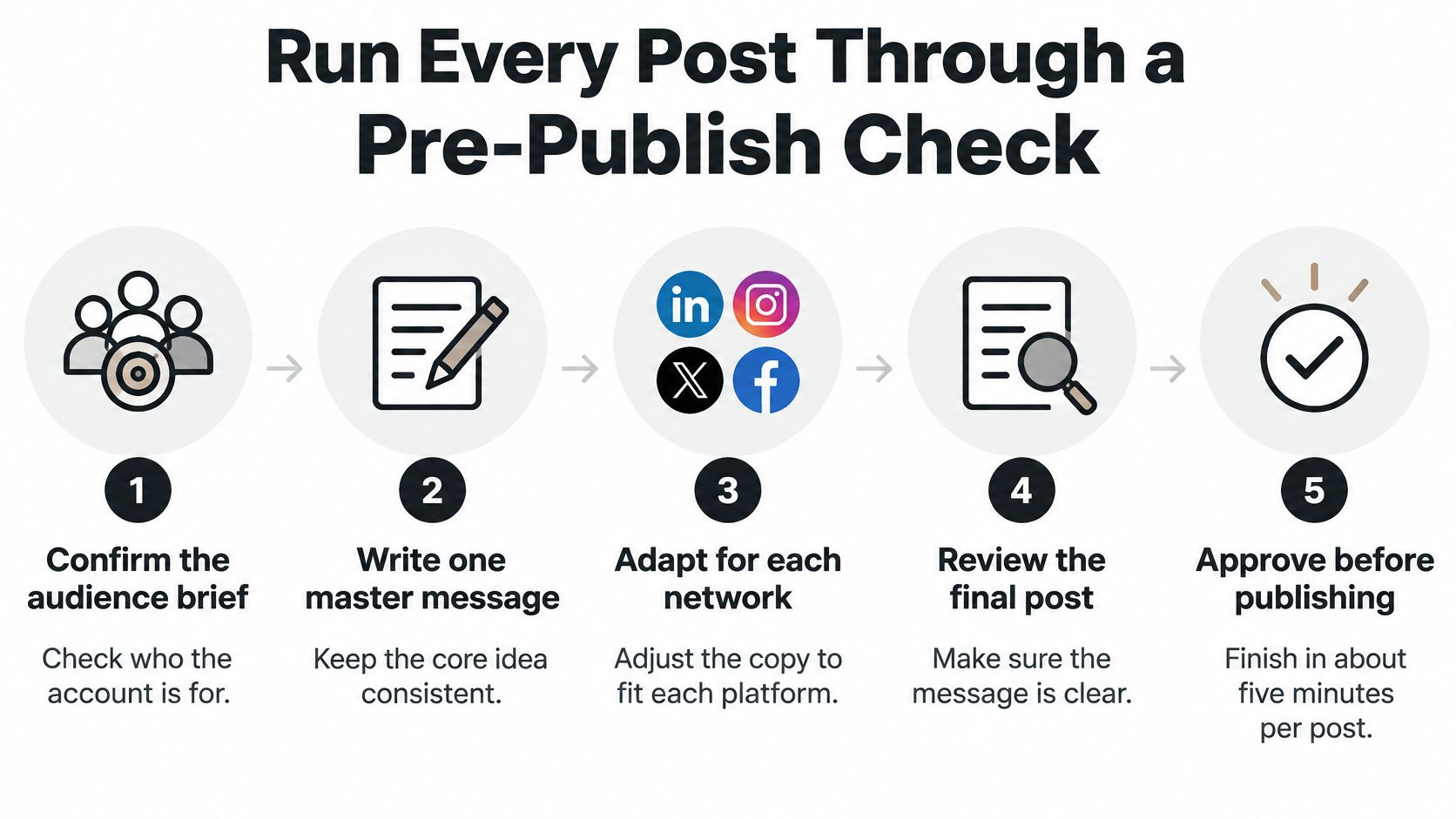
- Confirm the audience brief. Read the account's brief before opening the draft. If it's missing, write it, because a post without one is a guess with a publish button.
- Keep one master message. Verify the core claim and the offer match across every version shipping this week.
- Test the first line in the collapsed preview. Check where the platform cuts the caption and whether the point survives the cut.
- Check the ask. One primary call to action, worded for the reaction the post was built for.
- Verify claims and labels. Match every performance statement to evidence, and confirm the disclosure appears in plain words near the claim if the post is sponsored.
- Fix any AI draft. Add one firsthand detail, then read it beside a strong past post from the same account.
Judge results against the reaction, not the reach
Keep a shared sheet with one row per post listing the account, the network, the objective, the call to action, and the reaction the post was built for. Compare performance against that reaction. A post built for saves that earned 400 saves and modest reach is a success even if a reach-first report makes it look small.
Keep each call to action on its own row so the wording can be judged separately from the offer and the creative. Two posts with different asks and different images tell you nothing when their numbers are averaged together.
FoPost works in three steps: Connect, Write, and Publish. In the Write step, users type a post once, AI reshapes it for each platform's tone and limits, and users edit anything that doesn't sound like them. Per-network analytics show reach, engagement, and follower change for every connected account, so the review sheet and the results live in the same place, and the API and SDKs let developers send approved versions straight from their own code once the checklist passes.
Start with one live post this week. Pick the account that gets the least attention, run it through all six checks, publish, and look at its results in two weeks against the reaction you were aiming for. One tested post teaches a small team more than a month of untested output.
FoPost gives small teams one workspace to write a post once, reshape it for each network, schedule it, and read per-network results without juggling six tabs. If the checklist above is going to run weekly, FoPost's AI rewriting and 33-platform publishing remove the copy-paste step that usually breaks the habit. Visit FoPost to connect your accounts and put the first post through the six checks.