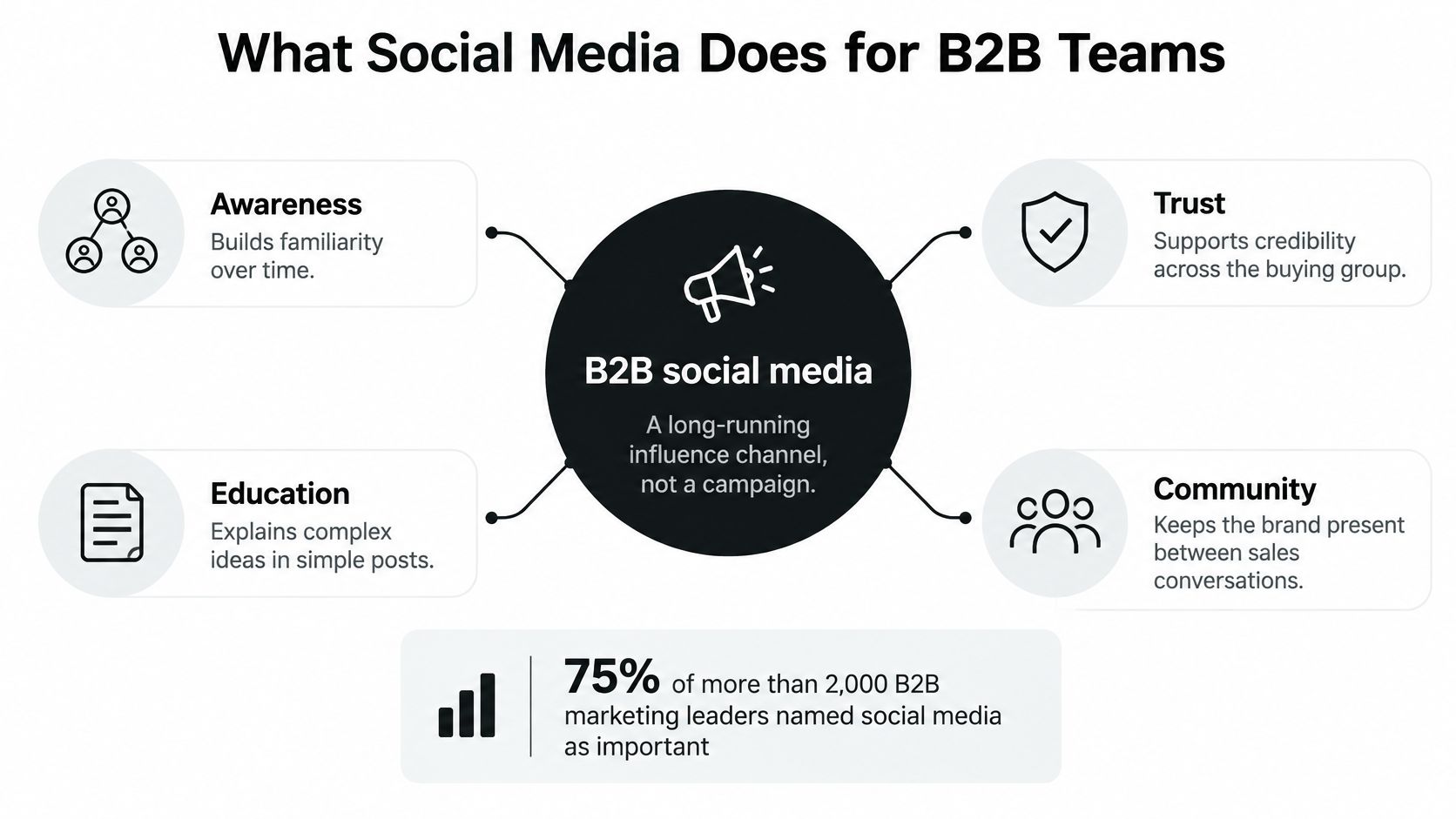
In the 2024 LinkedIn and Ipsos B2B Benchmark survey, 75% of more than 2,000 B2B marketing leaders across eight major markets selected social media as their most-used marketing channel, ahead of in-person events and trade shows at 51%. That establishes social's operational importance, not its contribution to revenue. B2B teams should treat it as a long-running influence channel, with content that helps buyers understand problems, evaluate options, and build confidence before a sales conversation.
Table of Contents
- What Social Media Does for B2B Teams
- Which Networks Do Which B2B Job
- How to Map Content to Buying Stages
- Who Buyers Trust and Which Messenger Fits
- Video Formats That Shorten Evaluation
- Measuring Influence Beyond Clicks
- Platform Limits to Plan Around Before You Scale
- Pick One Channel and Run a 90-Day Test
What Social Media Does for B2B Teams
Using social media business to business means influencing a buying group, not persuading a single consumer to check out. A technical evaluator, department head, and procurement lead need different information. A useful social program gives each person something worth remembering or sharing.
The older B2B model relied heavily on sales teams, trade publications, conferences, and direct outreach. Those channels still matter. Social adds a persistent place where buyers can inspect expertise between formal conversations.
A company page is a trade-show booth that stays open all year. The main work is staffing it, not renting it. Someone needs to answer questions, introduce useful ideas, and keep the material relevant.
Give every post a commercial job
- Thought leadership teaches the problem. A security engineer explaining why service accounts become difficult to govern helps buyers recognize an issue before they search for software. A generic prediction about digital transformation doesn't.
- Relationship building maintains contact. Comments, replies, and direct messages let employees stay useful to the same accounts over months. Dropping a sales link into every exchange turns that contact into interruption.
- Demand generation creates a next step. A migration checklist, implementation discussion, or relevant demonstration can move a named account toward a meeting. The next step should match the question the buyer is trying to answer.
These jobs connect through familiarity, education, trust, and participation.
Budget for the conversation
Small teams often budget for writing and design but leave nobody responsible for responses. That creates a polished feed with unanswered buying questions.
Assign a response owner alongside the publishing owner. For agencies managing several brands, that assignment also needs a clear escalation route for technical questions and customer complaints.
Practical rule: A publishing calendar isn't a social strategy unless someone owns what happens after publication.
A useful audit starts with the last ten posts. Label the job each performed, then cut or rewrite posts that served no clear buyer need.
Which Networks Do Which B2B Job
Network fit for B2B social media
The reported-value column separates perceived content value from ROI. They aren't interchangeable measures.
| Network | Best B2B job | Format that works | Reported value |
|---|---|---|---|
| Executive insight, recruiting, account engagement | Text posts, document carousels, short video | About 85% selected it among top-value platforms in the 2024 worldwide B2B content marketer survey reported by Statista. | |
| Reach among broader business audiences | Short video, community posts | 28% selected it in the same survey. | |
| YouTube | Longer demos and educational video | Tutorials, webinars, product walkthroughs | 22% selected it in the same survey. |
| Brand presence and employer branding | Reels, carousels, stories | In HubSpot's 2025 B2B marketing statistics, 29% of B2B marketers said Facebook and Instagram generated the greatest ROI among social channels. | |
| X | Industry commentary and quick updates | Short threads, links to research | Select when relevant buyers actively discuss the category there; no comparable survey value is established here. |
LinkedIn is the professional core in this comparison. Facebook offers access to broader business audiences, while YouTube gives technical explanations room to breathe. The platform selections show complementary uses, not a requirement to maintain every account.
The Instagram result needs particular care. It groups Facebook and Instagram together, so it doesn't establish Instagram's standalone return. Nor does a marketer's reported ROI predict results for a specific product.
Choose for the buying committee
Start where relevant buyers already participate. Then add a network only when the team can explain what new job it will perform.
Consider a security vendor. LinkedIn could carry executive commentary and conversations with technical evaluators. YouTube could host API demonstrations and deployment walkthroughs. Instagram should stay out of the plan unless customer behavior or a concrete employer-branding need justifies the work.
For visually led businesses weighing additional short-video channels, ContentBuck's Instagram vs TikTok breakdown is a useful comparison resource. The decision should still begin with audience fit, not the availability of another publishing destination.
- Inspect actual engagement. Review sales notes, discovery responses, and known account activity rather than follower totals.
- Count the maintenance work. Each additional account needs suitable creative, responses, permissions, and reporting.
- Keep inactive accounts deliberate. A basic company presence can be maintained without pretending it deserves an active content program.
For the last ten closed deals, list the networks where buyers first engaged when that information is available. Unknown entries should remain unknown, not become assumed LinkedIn wins.
How to Map Content to Buying Stages
Content becomes easier to commission when each post answers a buyer question. A stage label also prevents every asset from ending with the same request for a demo.
Build the stage map before the calendar
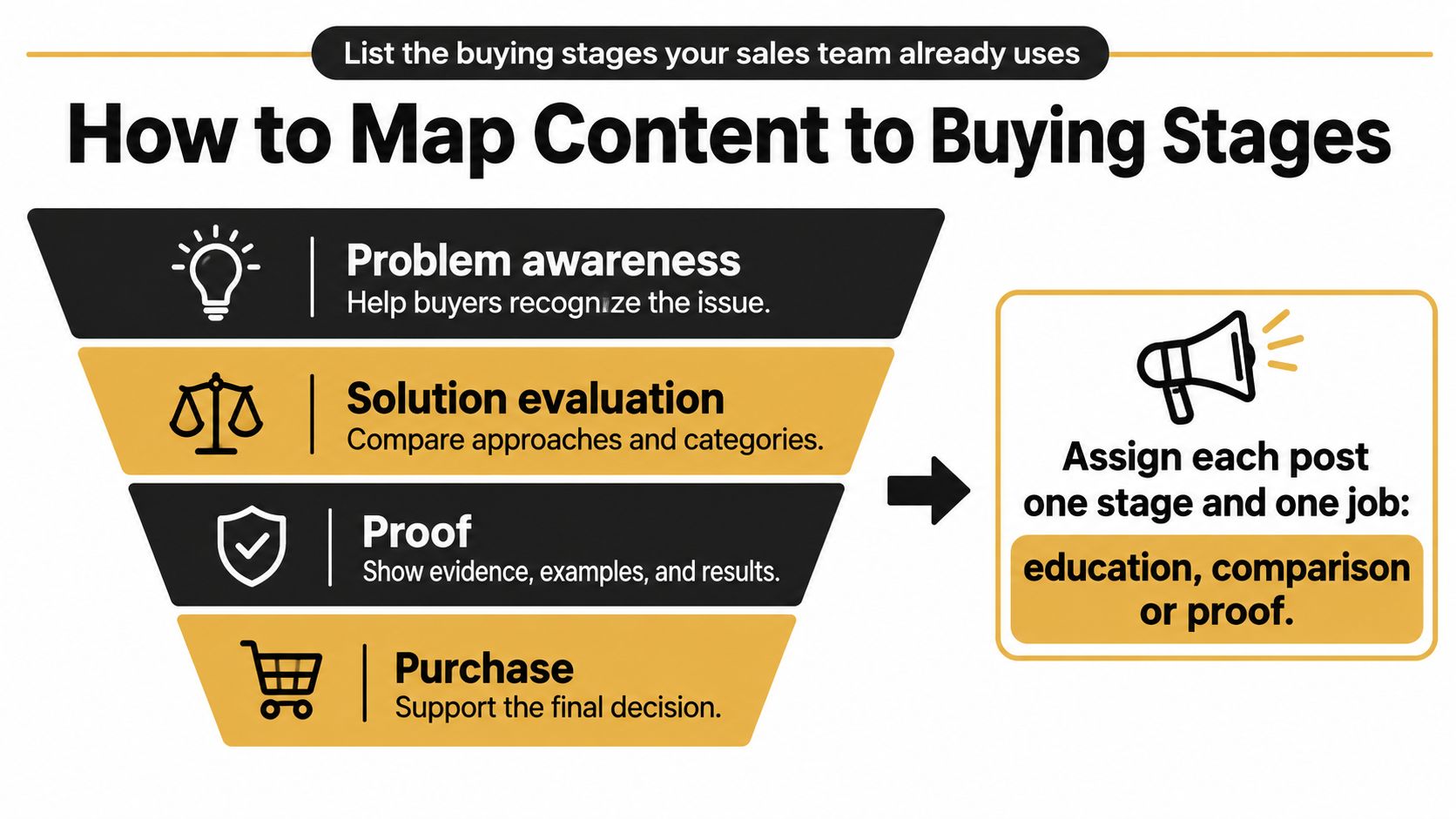
- Use the sales team's stage language. Start with problem awareness, solution evaluation, proof, and purchase, then reconcile those labels with the CRM so marketing and sales discuss the same progression.
- Assign a single primary job. Mark each post as education, comparison, or proof because a focused explanation is easier to understand than a compressed sales presentation.
- Keep a shared campaign ID. Attach the same identifier to network variants so a LinkedIn post and a YouTube walkthrough remain connected in reporting.
- Match the format to the question. Use explainers for unfamiliar problems, demonstrations for evaluation, and customer evidence for risk reduction.
- Name the technical reviewer. A subject-matter expert should approve claims, screenshots, and limitations before publication because confident wording can't repair an inaccurate explanation.
- Choose a stage-level response. Decide what progress should look like before publishing rather than treating impressions as the default success measure.
A workable social media content strategy should keep those fields beside the draft. A spreadsheet is sufficient if the team consistently records the stage, job, campaign ID, reviewer, and intended response.
The stage map should remain simple enough to use during production.
Turn a topic into a buying sequence
Say a database company wants to explain invoice automation. Its awareness post could show why inconsistent invoice fields cause downstream reconciliation problems. Its evaluation walkthrough could demonstrate how records move through the workflow.
A customer case study would address proof, including the implementation conditions and remaining manual work. Purchase-stage material could answer questions about migration responsibilities, access controls, and support.
Those assets shouldn't all use the same caption. Each addresses a different uncertainty, even when the underlying topic stays constant.
Exposure is an opportunity to influence a decision. It isn't evidence that a decision changed.
After a proposed 30-day review period, count the posts assigned to each stage and flag stages without measurable response; the influence model below supplies the measurement detail. The reason to separate exposure from progress is clear in Forrester's survey of more than 1,200 business-technology decision-makers in North America and Europe: 77% engaged with social media during work, yet 51% said it didn't play an important role in purchasing.
Who Buyers Trust and Which Messenger Fits
The messenger changes what a claim is worth. A feature statement from a vendor page, a caveat from a customer, and a migration note from an engineer can describe the same product and still answer different doubts.
The trust figures below come from Forrester's discussion of B2B buyers' trusted information sources. Use them to assign messengers to stage-specific uncertainty, not to assume that a trusted voice will close a deal by itself.
| Messenger | Trust reported | Where it fits |
|---|---|---|
| Coworkers and management | 82% of B2B buyers | Implementation realities and internal proof |
| Vendors already in use | 79% | Expansion, renewal, and adjacent products |
| Independent experts, including peers, analysts, and customers | 66% to 72% | Category framing and evaluation |
| Social media influencers | 44% | Awareness only within this operating model, with clear disclosure |
A company employee is persuasive only when the buyer can see the relationship and the knowledge behind the claim. Match the speaker to the uncertainty: an independent expert can frame a category without forcing a product conclusion, a customer can describe constraints and outcomes, and an employee can explain how implementation works while the company page distributes the explanation and adds context.
The strongest response is often private. A useful post may be forwarded into a buying-committee thread, pasted into procurement notes, or saved for a security review long before anyone clicks a public link.
Make participation voluntary and specific
Employee advocacy fails when every employee receives identical copy and an expectation to publish it. That turns knowledgeable people into distribution accounts.
- Get written opt-in. Participation should be voluntary, with permission to decline individual topics.
- Set approval boundaries. Review product claims, confidential details, and customer references without rewriting every sentence into corporate language.
- Name the relationship. A clear employer disclosure helps readers understand the speaker's position.
- Preserve personal wording. Employees should publish language they understand and would use in conversation.
Say a solutions engineer records a three-minute note about a migration pitfall. That fits evaluation, where the buyer is testing operational risk, and the company page can share it with a question inviting peers to describe their own approach. That creates a more useful exchange than a polished claim that migration is effortless.
AI can organize the transcript and adapt the format. It should not invent expertise, remove every qualification, or make every employee sound identical. Before publication, ask which messenger this buyer would trust at this stage and whether the claim would survive being pasted into a procurement thread.
Video Formats That Shorten Evaluation
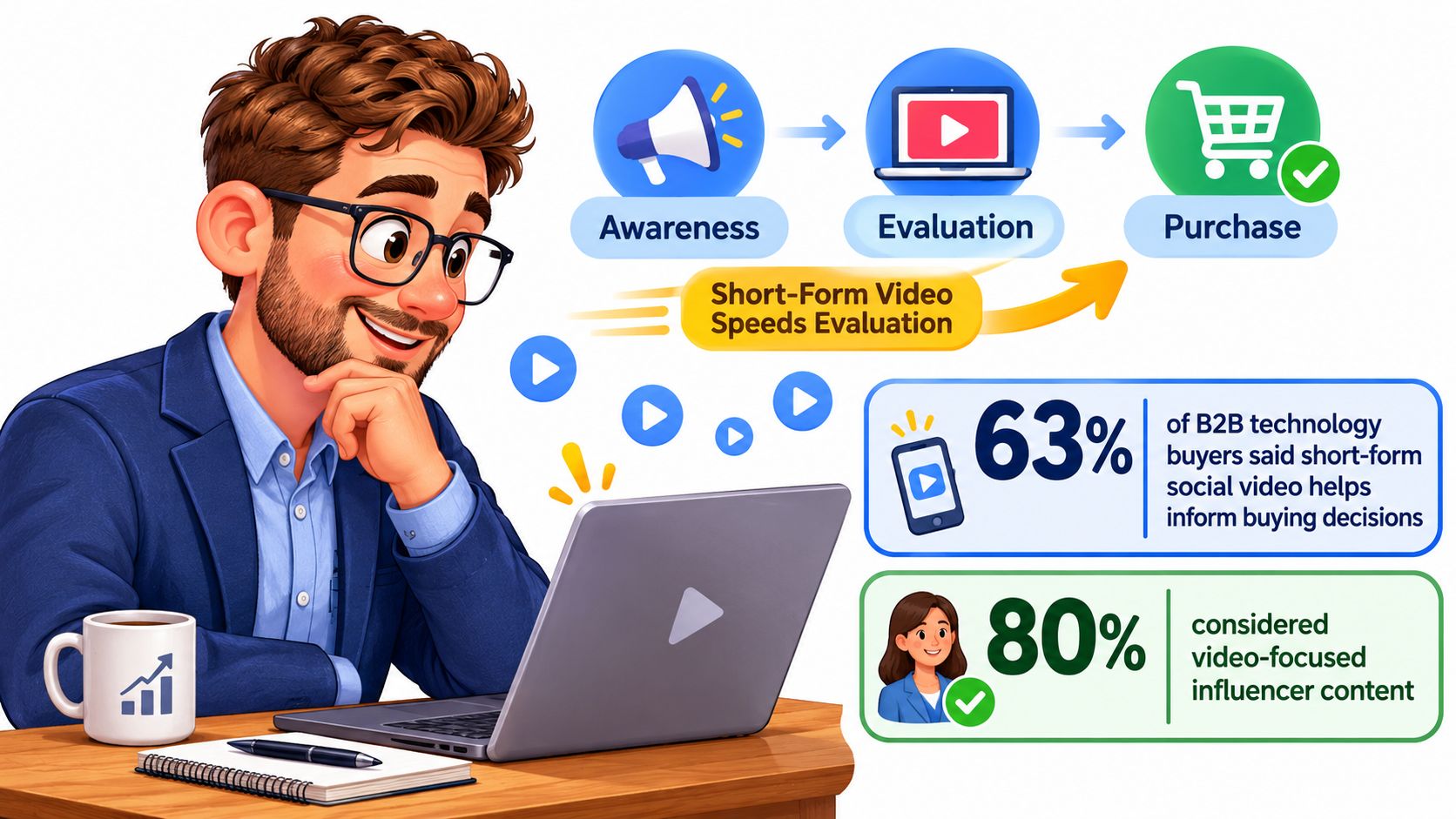
In LinkedIn's 2024 research commissioned from GWI, covering more than 1,700 B2B technology buyers and decision-makers in the United States, United Kingdom, and India, 63% said short-form social video helps inform buying decisions; among video consumers, 80% considered video-focused influencer content one of the most trusted content forms. That is a specific audience and format finding, not proof that any influencer endorsement will work.
A useful evaluation video makes an important part of the product observable.
Build the proof before the promotional clip
Consider a hypothetical integration vendor demonstrating failed-payment handling. The full recording shows the event arriving, the webhook payload, the retry behavior, and the final dashboard state.
A six-minute YouTube version could include chapters for setup, execution, and exceptions. A 45-second LinkedIn screen recording could isolate the retry step and explain the operational benefit. These are proposed production choices, not universal duration rules.
The short version shouldn't imply that the whole integration takes seconds. It should identify the demonstrated step and direct evaluators to the complete workflow.
For storyboard ideas, Trupeer Inc.’s examples of product walkthrough videos can help a team compare ways to show interfaces and outcomes. The useful question is what the buyer must see to judge the claim.
This embedded video offers another reference for reviewing presentation choices.
Adapt the demonstration to its destination
- Separate awareness from proof. Awareness clips frame the problem; proof assets show API behavior, security controls, migrations, or customer workflows.
- Prepare the right canvas. Create vertical and wide versions, keeping essential interface details readable.
- Support silent viewing. Add captions and explain any action that depends on narration.
- Lead with the value. Show the important result early, then explain how it happens.
- Choose a measurable next step. Direct evaluators to the full walkthrough, technical documentation, or a relevant conversation.
Cross-posting an identical file can hide interface details or cut away the evidence buyers need. A short-form video workflow should preserve the claim while changing the presentation.
Choose a proof asset to produce this month, then judge it using the metrics table below rather than views alone.
Measuring Influence Beyond Clicks
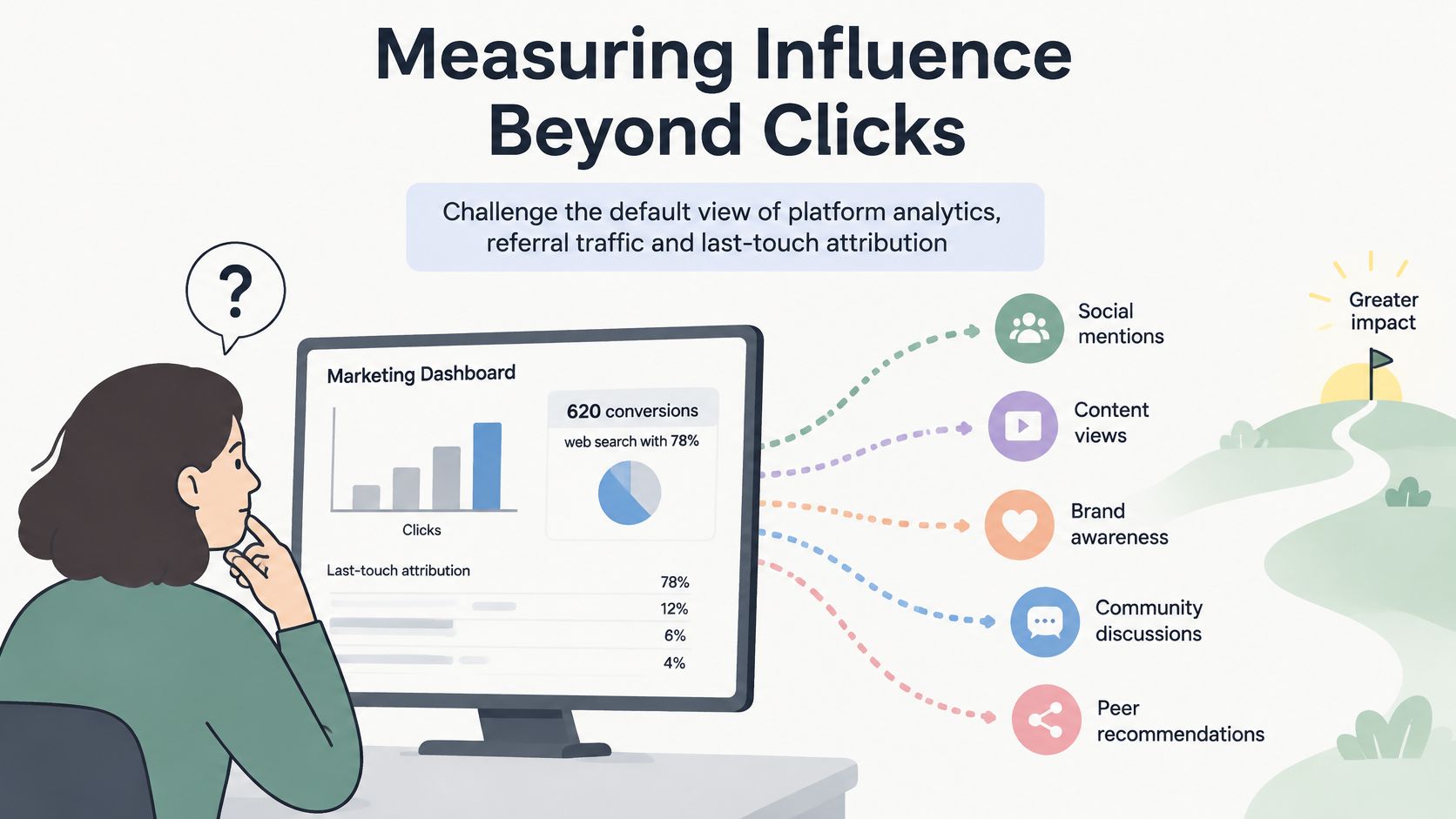
Last-touch attribution identifies the recorded conversion path, not every influence behind it. In Lead Forensics' discussion of dark social, an analysis of 620 conversions found that software credited web search with 78% of conversions, while customers self-reported search for only 12% and cited social, podcasts, word of mouth, or communities for 85%. That example demonstrates disagreement between measurement methods, not a universal allocation of B2B demand.
Private Slack threads, direct messages, email forwards, and closed-community discussions can circulate content without preserving a referral trail. A later branded search may receive conversion credit even when an earlier conversation created the interest.
The measurement task is to combine evidence without pretending that private activity can be tracked individually.
Metrics by buying stage
| Metric | What it tells the team | Limit |
|---|---|---|
| Impressions and reach | Exposure to the content during awareness | Says nothing about intent |
| Completion rate and saves | Educational or evaluation content held attention | Doesn't establish buyer identity |
| Qualified profile visits | Possible interest from target accounts | Needs account matching |
| Replies and inbox conversations | Direct buyer engagement | Small volume for most brands |
| Branded search and direct visits | Possible delayed influence | Can't be tied to a single post |
| Meetings and pipeline influenced | Commercial outcome | Requires CRM tagging and self-reports |
Not every platform exposes enough identity information to qualify a visitor. Teams should use only available, permitted information and leave unmatched activity unclassified.
Combine recorded activity with buyer explanations
- Tag the campaign context. Record the intended buying committee or target account without treating that label as evidence of exposure.
- Add a discovery question. Use a free-text field asking how the prospect first heard about the business on a high-intent form.
- Preserve the original answer. Keep the wording alongside a normalized discovery category in the CRM.
- Log sales-call evidence. Record content or conversations prospects mention, including uncertainty about where discovery began.
- Review delayed signals. Compare branded-search trends and direct visits with campaign timing, while checking other possible causes.
A consistent social media analytics tracking process makes those inputs easier to reconcile. Analytics and self-reports should sit beside each other rather than overwrite each other.
A low-click post can still create demand. Private sharing is a plausible explanation, not automatic credit.
Report a conservative range of influenced opportunities with the supporting evidence and inclusion rules. Don't convert incomplete observations into a precise revenue claim.
Platform Limits to Plan Around Before You Scale
Publishing limits and permission scopes differ enough across networks that a connected account tells you little about what a scheduled post can do. Check both before automating across accounts. A connected account doesn't guarantee that a scheduled post can be published publicly.
Publishing limits by network
| Network | Limit or rule | Plan impact |
|---|---|---|
| The Instagram Graph API quota example shows 50 published containers per account during a 24-hour period. | Read quota_usage and quota_total through content_publishing_limit before publishing. | |
The LinkedIn Posts API requires w_organization_social and an authorizing member with ADMINISTRATOR, DIRECT_SPONSORED_CONTENT_POSTER, or CONTENT_ADMIN access to the Page. | Confirm permission and the member's role for each Page. | |
| TikTok | Under TikTok's content-sharing guidelines, unaudited clients allow no more than five posting users per 24 hours, require private accounts, and restrict posts to SELF_ONLY; Direct Post typically caps creators at around 15 posts daily across clients. | Confirm audit status. Later public visibility requires the owner to make the account public and change each video to Everyone. |
| YouTube | The YouTube Data API quota guide sets a default daily allowance of 10,000 units that resets at midnight Pacific Time, where a search.list request costs 100 units, a videos.insert upload costs 1,600 units, and every request, including invalid ones, costs at least one unit. | Separate search, upload, metadata, and monitoring workloads; log channel activity against project capacity. |
Two of these limits shape the channel plan directly. An unaudited TikTok client publishes only to private, self-only views, so buyer-facing video on that network waits for the audit and a manual visibility change. On YouTube, each upload consumes a meaningful share of the daily unit allowance, which leaves less room for the search and monitoring calls a scaled workflow runs alongside it.
Make failures recoverable
Instagram workflows need to handle a container that exists but can't yet be published because quota is exhausted. The recovery path is to hold the publish until the 24-hour window frees capacity rather than resubmitting immediately. Permission failures need a different response from temporary service failures: a missing LinkedIn scope or Page role won't resolve on its own, while a transient error might.
Classify failures before retrying. Blind retries can consume capacity without fixing an invalid request or missing authorization, and on YouTube even an invalid request costs at least one unit, so repeated bad calls drain the same allowance that valid uploads need.
Track account-level limits where the network imposes them and project-level limits where they apply instead. Stop invalid requests, surface the cause, and give the account owner a concrete recovery action: reauthorize the member, request the Page role, or wait for the quota window to pass.
Pick One Channel and Run a 90-Day Test
Choose a primary network and a stage focus before expanding the account roster. The test should establish whether the team can repeatedly produce useful content and observe meaningful buyer responses.
Keep the test small enough to diagnose
- Choose from deal evidence. Review the last ten deals and select the network with the clearest documented buyer engagement.
- Draft twelve posts. Allocate four each to awareness, evaluation, and proof, including a substantive proof asset. Treat purchase-stage questions as sales-support material during this initial test.
- Assign the speaker and reviewer. Name the messenger, technical approver, and response owner before scheduling.
- Add the discovery field. Put the free-text question on a high-intent form and preserve responses in the CRM.
- Review at days 30, 60, and 90. Compare meetings, qualified profile visits where available, and branded-search signals. Cut the current content treatment for an unresponsive stage and investigate the topic, messenger, and distribution before replacing it.
FoPost lets teams write a post once, adapt it for each network, schedule, publish, and measure results across 33 networks from a single workspace. It also supports publishing from RSS feeds, blogs, and webhook triggers with human-in-the-loop approval. Those capabilities don't replace the stage plan or measurement model.
The first action this week is to write the twelve post briefs and assign an owner for each stage.
FoPost brings multi-account publishing, AI-assisted adaptation, and developer APIs and SDKs into a shared workflow. Visit the platform to put an approved B2B content plan into production, starting with the channel selected for the test.