A single unanswered public complaint can become the most visible account of a brand. Reputation management and social media now meet in daily operations, not in occasional press statements. Small teams need a practical system for detection, triage, response, verification, and review. The system works when owners, response targets, and approval rules are clear before a difficult post appears.
Table of Contents
- Why Social Media Turned Reputation Into a Live Operation
- Response Time Benchmarks Your Team Should Know
- How to Build a Monitoring Loop That Catches Problems Early
- Triage Rules for Complaints, Questions and Coordinated Attacks
- Handling Sensitive Complaints Without Going Silent
- Checking Claims and Keeping One Story During a Crisis
- Set Up a One-Week Reputation Monitoring Trial
Why Social Media Turned Reputation Into a Live Operation
A delivery problem appears in a comment thread at 9.05 a.m. By 9.20 a.m., other customers have added screenshots, asked whether refunds exist, and tagged friends. The community manager is still waiting for approval from a manager in a meeting. That gap is the modern reputation problem.
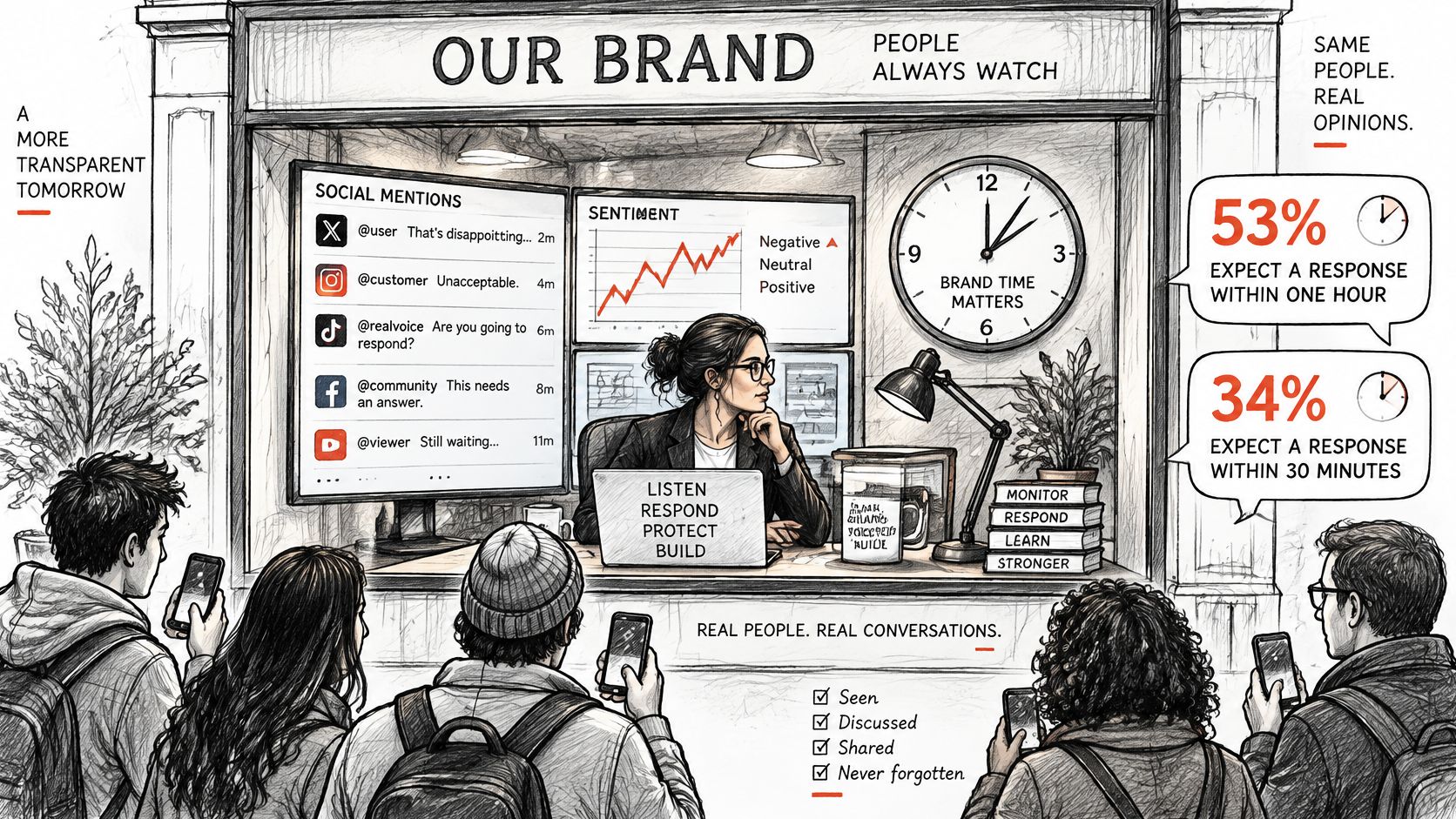
The 2019 Crisis Impact Report covered by TechRepublic surveyed 2,000 consumers in the United States and United Kingdom and found that 53% expected a brand to respond to a crisis within one hour, while 34% expected a response within 30 minutes. Social media was the preferred channel for receiving a crisis response for 47% of respondents.
From Notice Board to Shop Window
Old public relations resembled a notice board in a back office. A team drafted, approved, and released a statement on a news cycle. Social feeds resemble a shop window on a busy street. Customers, employees, journalists, and competitors can watch and react at the same time.
Sharing also moves faster in public. The same report found that 40% were more likely to share news of a brand crisis on social media, compared with 29% face to face. A complaint therefore doesn't stay between one customer and one support agent. It becomes evidence for everyone considering a purchase.
What Good Handling Protects
The commercial stake is direct. 90% of respondents said they were more likely to shop with a brand that handled a crisis well. Teams building broader skills around owned and social channels sometimes use a self-paced digital marketing course from London School of Business Administration to connect publishing discipline with customer communication.
The most frequently identified failures show where operations break:
- Not accepting responsibility: 28% identified this failure.
- Failing to acknowledge the crisis: 20% identified this failure.
- Not offering a preventive solution: 15% identified this failure.
- Responding too slowly: 13% identified this failure.
Practical benchmark: Detect quickly, acknowledge clearly, offer a credible remedy, and keep updates consistent across channels.
That sequence turns reputation from a sentiment score into an operating routine. Detection without authority creates delay. Speed without responsibility creates distrust. A remedy without follow-up leaves the original complaint as the final public record.
Response Time Benchmarks Your Team Should Know
Response targets need to reflect where the complaint appears and how public it is. A private billing question doesn't carry the same immediate audience as a safety complaint under a promoted post. Teams should set stricter targets for visible, urgent, and high-reach items.
| Channel or situation | Response expectation | Source or note |
|---|---|---|
| Public complaint on Twitter (X) | About 3 hours | Expectation in academic review; observed means 1 to 3 hours |
| Public complaint on Facebook | About 6 hours | Expectation in academic review; observed means 1 to 3 hours |
| Any complaint, consumer survey | Within 24 hours for 68% of respondents | Sprout Social 2026 consumer survey |
| Urgent complaint, consumer survey | Under 1 hour for 14%; 1 to 2 hours for 24% | Sprout Social 2026 consumer survey |
| Preferred complaint channel | Direct message for 55%; comment for 31%; public tag for 13% | Sprout Social 2026 consumer survey |
| Public complainers seeking private follow-up | 33% wanted a reply pointing to direct messages | Sprout Social 2026 consumer survey |
What the Channel Numbers Mean
An academic review of webcare research found that consumers who complained on Twitter expected a response within approximately three hours, while Facebook users expected one within six hours. Observed mean response times were one to three hours, and faster responses correlated with higher satisfaction.
That finding doesn't prove that any fast reply works. A quick but wrong answer can create a second problem. The safer interpretation is narrow. Speed matters, but acknowledgement still needs accurate information and a named next step.
The 2026 Sprout Social consumer survey found that 68% expected a response within 24 hours, including 24% who expected a response within one to two hours and 14% who expected one in under an hour. It also found that 55% preferred contacting a company through direct messages for a complaint, 31% would leave a comment, and 13% would tag the brand publicly.
When Targets Should Tighten
Three conditions should override a standard target.
- Safety or fraud is named: Treat the item as urgent, even before every fact is confirmed.
- Reach is growing: Prioritize a complaint gathering replies, shares, or media attention.
- Personal data appears: Move details into a private channel and leave a brief public acknowledgement.
Among people who complained publicly in the Sprout Social survey, 33% wanted a reply directing them to direct messages, while 28% expected the issue to be resolved in the comments. That split supports a two-part reply. Acknowledge the issue publicly, state that details are being handled privately, and return with a public closure when the customer agrees.
Overnight coverage changes capacity, not principle. A small team can publish clear support hours and use a holding reply outside those hours. Silence without any signal looks like neglect because social platforms create an expectation of near-real-time contact.
How to Build a Monitoring Loop That Catches Problems Early
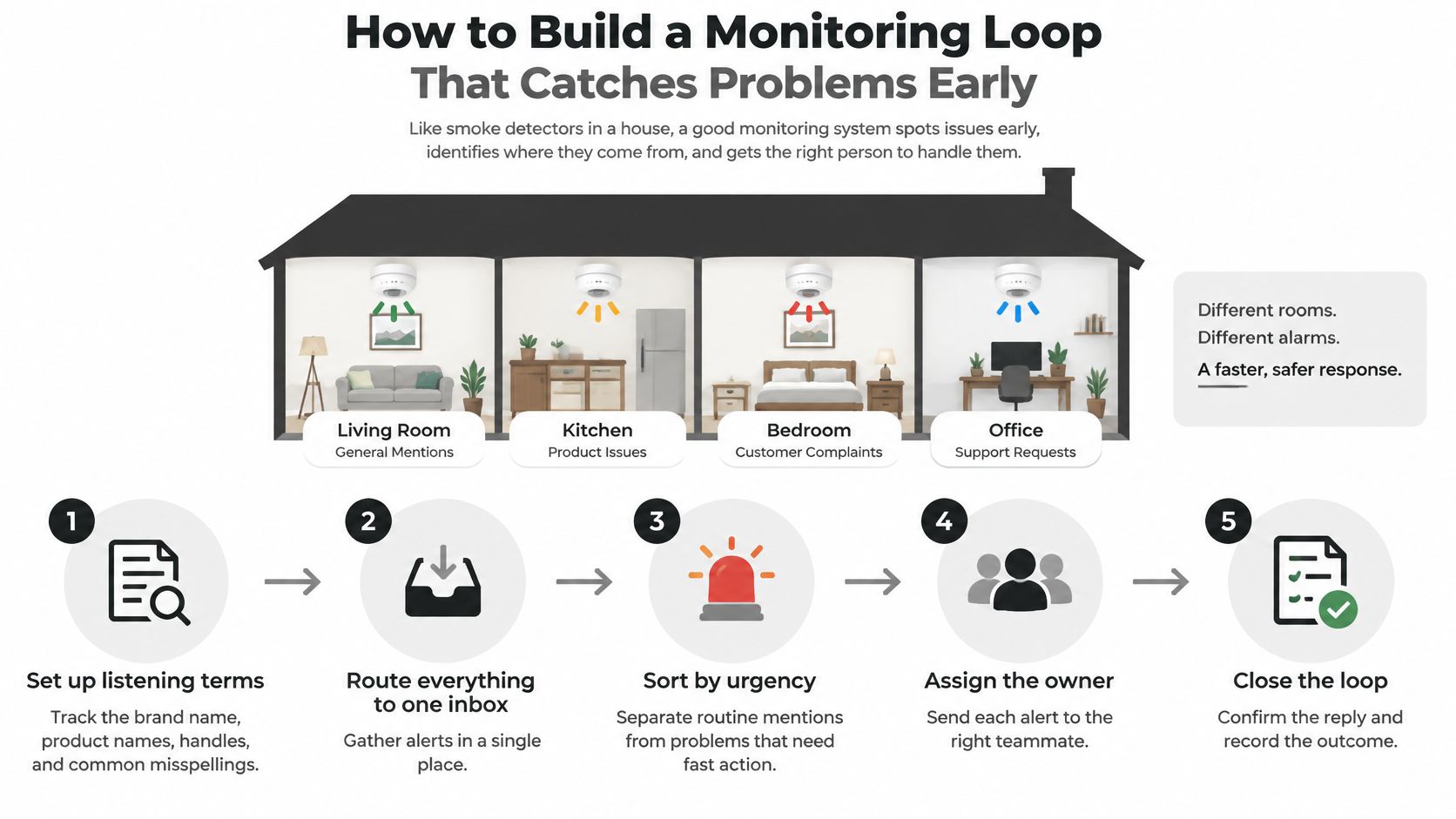
A monitoring loop works like a smoke detector that also sorts each alarm by room. Detection alone is not enough. The system must identify where the problem appeared, how serious it is, who owns it, and whether the response closed it.
The Seven-Step Routine
- Set up listening terms. Track the brand name, product names, handles, common misspellings, executive names where relevant, and campaign hashtags on every active network. Keep those terms in a social listening workflow or shared queue so coverage does not depend on someone remembering manual searches.
- Pull everything into one inbox. Mentions, comments, tags, and direct messages should arrive in one queue. Items left inside separate native apps are easy to miss during holidays, shift changes, and account handovers.
- Tag every item on arrival. Record network, sentiment, severity, account, topic, and whether personal data is present. Add a flag for safety, privacy, labor, or misinformation claims so sensitive items enter the loop already marked for tighter handling.
- Route by risk, not arrival order. High-reach posts, strongly negative complaints, safety claims, media questions, and unsupported claims moving quickly go to the front. The response clock starts when the item arrives, not when someone notices it.
- Draft carefully and label assistance. Templates and AI-generated suggestions can speed drafting, but each draft should stay visibly marked as unapproved until a person checks facts, tone, links, names, and whether a public claim needs evidence behind it.
- Log approval and publication. Record who approved each reply, what version was approved, and when it went live. The log matters when a customer disputes wording or when several regional accounts answer the same question differently.
- Review the loop weekly. Check median and 90th-percentile time to first human response by network, unresolved items, escalations, repeat complaints, and corrections issued after publication. Then change one rule, template, or routing decision based on the evidence.
The Measurement Mistake to Avoid
Reply volume is a weak measure. A team can answer many easy questions while serious complaints wait through a weekend. Time to first human response shows whether customers receive attention while the issue is still containable.
The median shows typical performance. The 90th percentile exposes the slow tail, where overnight gaps, unclear ownership, approval bottlenecks, and sensitive items usually sit. Split both numbers by network because customer expectations and staffing patterns differ by channel.
A monitoring tool doesn't protect reputation by collecting mentions. Protection comes from routing, approval, response, and review happening in the same loop.
A practical weekly meeting needs only four questions. Which items waited longest. Which topics repeated. Which replies required correction. Which product or policy issue should leave the social team and reach an owner elsewhere in the business. Those answers turn public feedback into operating fixes instead of a growing archive of apologies.
Triage Rules for Complaints, Questions and Coordinated Attacks
Triage prevents every mention from receiving the same urgency. It also prevents urgent items from waiting behind routine questions. The targets in the table are internal team targets built from the response expectations already discussed, not universal industry standards.
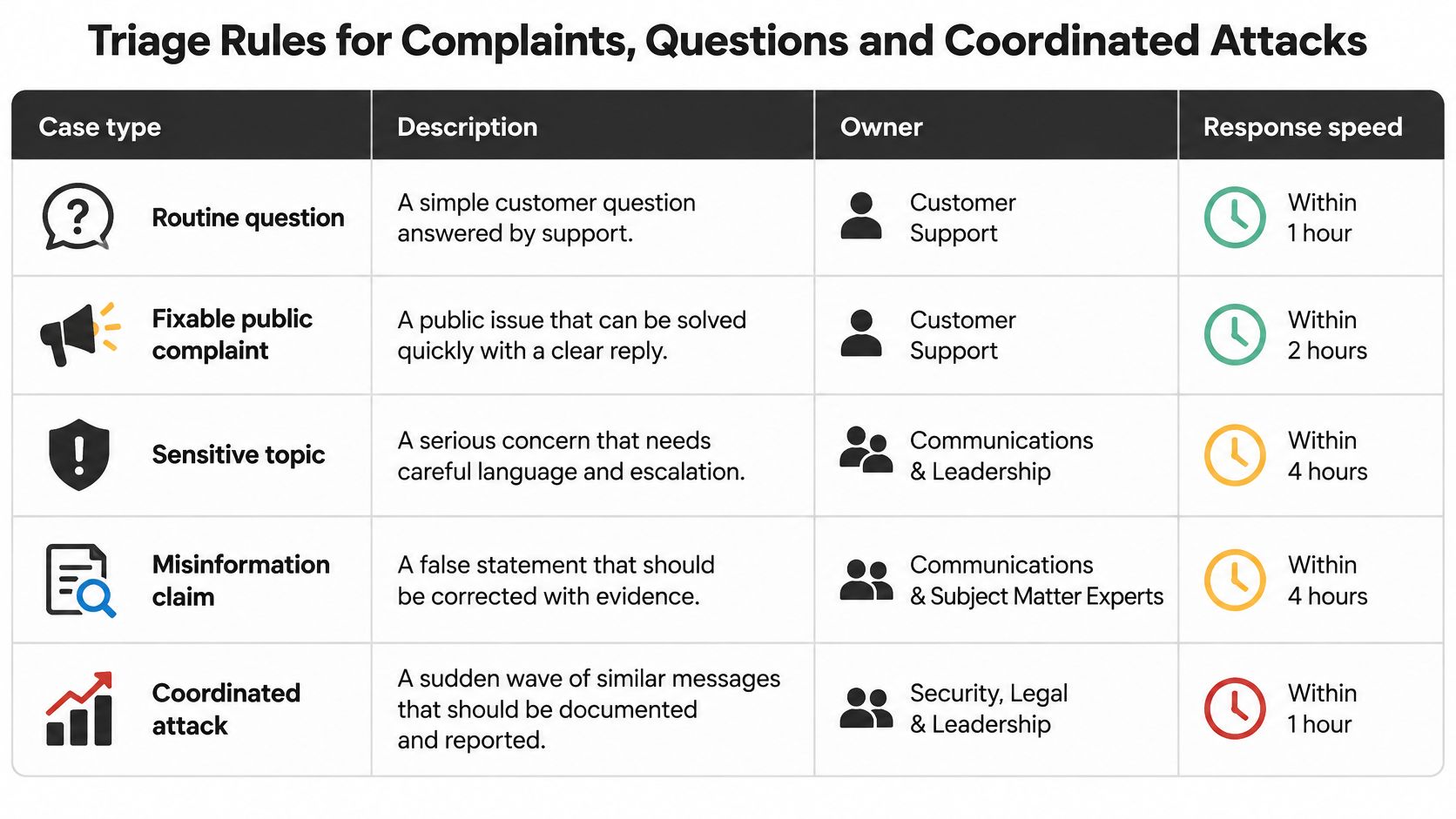
| Case type | Example | Who responds | Suggested first response |
|---|---|---|---|
| Routine question | Store hours or product availability | Community manager | Within 24 hours |
| Fixable public complaint | Late order shared in comments | Support lead, moves details to direct messages | Within 1 hour, with public acknowledgement |
| Sensitive topic | Labor, privacy, DEI or safety concern | Senior reviewer with legal sign-off | Within 2 hours, holding reply first |
| Misinformation claim | False claim about pricing or product safety | Named verifier, then correction owner | Within 4 hours after evidence check |
| Coordinated attack | Many accounts posting the same claim | Escalation lead; pause scheduled posts | Escalate within 1 hour and preserve evidence |
How Ownership Should Work
Community managers can answer routine questions from approved information. Product availability, opening hours, sizing, and event details shouldn't wait for senior approval. Speed improves when low-risk authority is explicit.
Support leads should own fixable public complaints. The public reply acknowledges the problem and gives a case reference or clear next step. Order numbers, addresses, payment details, and health information move into direct messages or a secure support channel.
Sensitive topics need a senior reviewer. Labor practices, discrimination, privacy, accessibility, safety, and political conduct can create legal and ethical consequences beyond one thread. Legal review may be necessary, but legal review shouldn't become a reason for complete silence. A short holding reply can confirm receipt and give a time for a fuller answer.
Misinformation needs a named verifier before correction. That person checks the original source, internal records, dates, images, and whether the claim has changed as it spread. A correction written before verification can amplify an error or deny something that later proves partly true.
Coordinated attacks need documentation first. Preserve URLs, timestamps, account names, screenshots, and examples of repeated wording. Pause scheduled promotional posts that could look careless beside a serious allegation, then decide whether platform reporting, a public statement, or no public response is appropriate.
Rules That Change With Team Shape
A team without overnight cover can widen targets for routine questions outside working hours. Safety, fraud, and active harm claims still need an escalation route. Published support hours help only when the holding message is accurate and monitored.
Regional account structures need regional owners. Language, consumer law, holidays, and product availability differ by market. A central team can set categories and escalation thresholds, while local owners handle context. Teams formalizing that reporting can also review guidance on measuring social media reputation from Carlos Alba Media alongside internal response records.
Handling Sensitive Complaints Without Going Silent
A complaint about a broken feature usually gets an answer. A complaint about labor practices, discrimination, or political conduct often gets silence. In a 2025 study comparing U.S. and German companies, researchers counted 3,125 user complaints and only 469 company responses, a response rate of 15%, with product and service complaints far more likely to receive a reply than complaints about DEI or other sensitive topics.
That pattern is understandable. It is also risky. Product problems often have a known fix. Complaints about ethics, labor, privacy, discrimination, or political conduct involve judgment, evidence, and sometimes legal review. Teams delay because they fear saying the wrong thing. The delay itself becomes the public message.
Responding Well Is Not the Same as Responding More
Answering everything does not mean answering well. Experimental work summarized in the same study found accommodative responses outperformed defensive ones, with the strongest results coming from a combination of empathy, an apology, and a promise of corrective action. A defensive reply may satisfy internal stakeholders while confirming the complainant's concern to everyone watching.
Human identification matters too. Customers tend to respond better when a named, accountable person is visible in the reply instead of an anonymous corporate profile. That does not require every agent to post from a personal account. A first name and role in the signature, or a named owner who follows the case through the thread, carries the same signal.
A Copyable Response Pattern
Sensitive replies should contain four parts:
- Name the responder or responsible team. Avoid an anonymous corporate voice where policy allows a named representative.
- Acknowledge the concern in plain words. Restate the issue without minimizing it or arguing about intent.
- State an action and reporting date. Name the review, correction, refund process, policy check, or investigation step that will happen.
- Move personal details privately. Use a secure channel for records, then return to the public thread with an outcome when privacy permits.
A shared social inbox for comments and messages keeps the public acknowledgement, the private follow-up, the owner, and the approval history attached to the same case. That continuity matters when a conversation outlasts one shift.
Silence may be defensible. Unexplained silence rarely is.
When Not Replying Publicly Can Be Justified
Three situations can justify withholding a substantive public reply. A legal matter may be under active review. An allegation may be unverified and unsafe to repeat. A case may involve personal data that cannot be discussed publicly.
Even then, the decision needs a record. Log the reviewer, the reason, the evidence checked, and the review date. Post a holding statement when public interest is clear: confirm the concern is under review, give a safe contact route, and state when an update will follow.
The important decision covers more than speed. It involves who responds, how human the reply sounds, what action accompanies it, and whether any silence has a documented reason.
Checking Claims and Keeping One Story During a Crisis
Consistency matters as much as speed during a crisis. A 2026 applied study in Frontiers in Communication reported positive relationships between transparent communication and restored trust (β = 0.401, p = 0.002), response speed and organizational effectiveness (β = 0.393, p = 0.001), and cross-channel message consistency and restored trust (β = 0.531, p < 0.001). Transparency plus message consistency explained 44.7% of the variance in user trust, while speed explained 15.5% of variance in perceived effectiveness.
Those relationships point to three separate jobs. Speed limits damage during the attention spike. Transparency reduces uncertainty. Consistency stops audiences from finding contradictory explanations on Instagram, LinkedIn, X, and Facebook.
Build From One Source of Truth
A crisis workspace should hold one approved statement. It needs the confirmed facts, the unknowns, the action being taken, the next update time, and the contact route. Platform versions should be adapted from that statement, not written independently by each channel owner.
Material claims require human review. Dates, eligibility rules, safety instructions, refund terms, and legal statements shouldn't be paraphrased from memory. The publishing log should show which version went live on each network, who approved it, and whether a correction replaced it.
Short formats create a special risk. A condensed post can drop a condition that changes the meaning of a promise. Reviewers should compare every platform version against the source statement, with special attention to numbers, deadlines, geography, and words such as all, every, guaranteed, and immediate.
Verification Routine for False or Misleading Claims
- Classify by evidence and potential harm. Separate unsupported opinion, factual error, manipulated media, impersonation, and coordinated manipulation.
- Preserve the record. Save screenshots, URLs, account names, timestamps, and the earliest version that can be found.
- Check the original source. Compare the claim with product records, transaction data, official documents, and full video or image context.
- Avoid repeating the false claim in a headline. Lead with the verified fact so the correction doesn't spread the error more efficiently than the original.
- Label uncertain media as unverified. Suspected AI-generated or altered material should stay unverified until a named person confirms its source.
- Correct only when clarity improves. A low-reach error may need monitoring rather than a public post that introduces it to a larger audience.
- Escalate high-risk allegations. Legal, safety, fraud, and impersonation claims go to a named owner with authority to act.
What the Evidence Does Not Prove
The study relationships are observational, not proof that a given increase in consistency will produce a fixed increase in trust. Teams shouldn't treat 44.7% or 15.5% as universal benchmarks for a bakery, software company, university, or airline.
A better approach is to declare measures before an incident. Track sentiment change, complaint volume, correction requests, reshares, recovery time, response latency, and divergence between message versions. Afterward, compare incidents with similar reach and severity. That discipline shows whether faster approval or tighter message control improved outcomes for that organization.
Set Up a One-Week Reputation Monitoring Trial
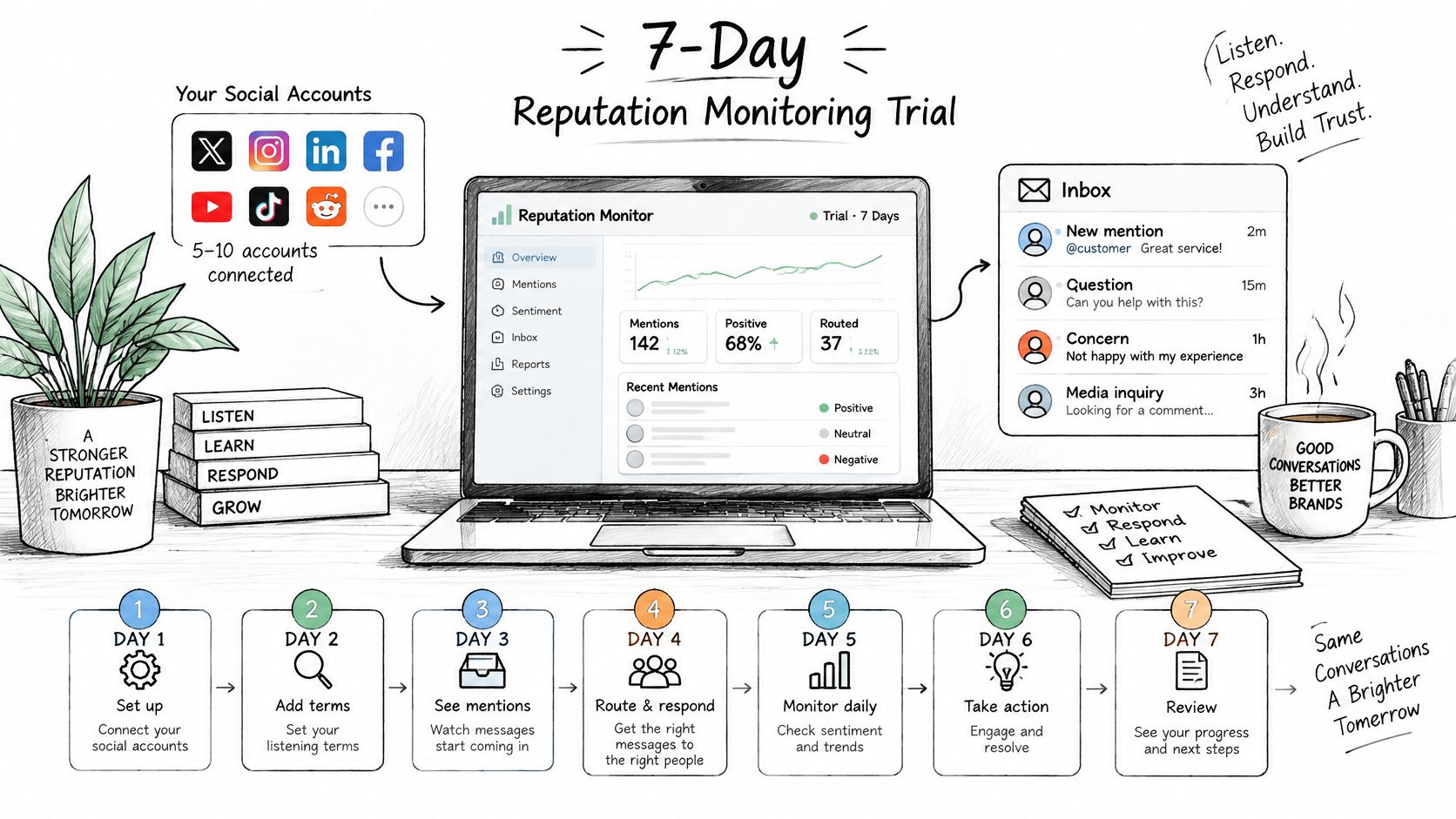
A one-week trial is enough to expose missing owners, slow approvals, and unmonitored accounts. Start with the five to ten accounts receiving the most comments and messages, rather than trying to redesign every channel at once.
Seven-Day Checklist
- Day 1: Add listening terms for brand names, products, handles, and misspellings. Connect priority accounts to one inbox and confirm that alerts reach a monitored place.
- Day 2: Write the triage table with case types, owners, escalation routes, and first-response targets. Tool selection can be checked against a Reputation software review from TopToolAdvisor when reporting and approval needs are unclear.
- Day 3: Prepare a source-of-truth statement for the two topics most likely to cause confusion. Add a holding reply for sensitive questions and a private follow-up template.
- Days 4 and 5: Run the loop during normal publishing. Log every approval, escalation, correction, and unresolved item.
- Days 6 and 7: Review median and 90th-percentile first-response time by network, repeat complaints, and escalations. A structured social media report format can keep those measures separate from ordinary engagement reporting.
No specific tool is required for the trial. FoPost is an AI-powered social media management platform with a Social Inbox under Create & Publish. Its AI features include per-platform content rewriting, Brand Voice profiles, the FoPost Agent chat planner, and inbox reply suggestions. The same checklist still applies in any system that records ownership, approvals, and response times.
End the week by choosing one number to fix first. Use the 90th-percentile response time on public complaints. It shows how long the slowest visible cases wait, making it the clearest target for staffing, routing, or approval changes in the following week.
Start the trial with the accounts that receive the most public feedback, connect them in FoPost, and use one inbox, clear approvals, and platform-specific drafts to keep responses fast and consistent. The first goal is simple. Shorten the wait on the slowest public complaints and prove the improvement in the weekly review.