
52% of respondents identified social media as the technology that generated the highest number of quality leads during the previous year in the NAR 2024 Technology Survey. That doesn't mean another listing graphic will close a deal. It means real estate social media deserves a defined role in the sales process, with useful information, clear evidence, and a measurable next step.
For a small team, the strongest approach isn't to maintain a busy feed everywhere. It's to help buyers understand a market, evaluate a property, and feel comfortable booking a conversation. Platform choice, content formats, publishing checks, and lead tracking should serve those decisions.
Which Networks Real Estate Clients Actually Use
| Platform | Agents using it (NAR 2024) | U.S. consumers using it for housing content (Realtor.com 2025) | Best use |
|---|---|---|---|
| 87% | 57% | Local updates and listing posts | |
| 62% | Not reported in the cited findings | Short listing videos and Reels | |
| 48% | Not reported in the cited findings | Market commentary and agent credibility | |
| YouTube | 25% | 73% | Buyer education and walkthroughs |
| TikTok | 15% | Not reported in the cited findings | Short property walkthroughs |
| X | 10% | Not reported in the cited findings | Market news and quick updates |
Agent adoption figures come from the NAR 2024 Technology Survey summary, with TikTok at 15% and X at 10% documented in the NAR survey linked in the introduction. The consumer column comes from Realtor.com's 2025 housing survey, which found YouTube usage at 73% and Facebook usage at 57% among surveyed U.S. consumers using platforms for housing-related content.
These columns aren't a conversion comparison. They describe different groups, different years, and different activities. Agent adoption shows where professionals publish, while consumer usage indicates where buyers and other consumers encounter housing information.
The useful contrast is YouTube. Agent familiarity with Facebook and Instagram shouldn't automatically determine where a team invests its production time. A buyer trying to understand an inspection or compare neighborhoods needs more explanation than a listing thumbnail provides.
Choose a job before choosing a network
A practical starting plan for a two-person team is Facebook for local listing updates and YouTube for a weekly buyer-education video. One person owns factual review and responses. The other handles recording, editing, and publishing. This is a proposed operating plan, not a universal posting benchmark.
Instagram becomes a sensible addition when the team already has strong vertical footage. LinkedIn fits an agent who can explain local market conditions clearly and wants professional contacts to recognize that expertise. TikTok and X shouldn't become automatic obligations just because accounts are available.
For teams commissioning photography or walkthrough footage, Pinnacle Property Media's resource on professional listing media for social campaigns provides a useful planning reference. The practical question is whether the shoot produces assets for the intended channels, not merely attractive images.
Selection rule: A network earns its place when the team can name the buyer question it will answer there and sustain the work required.
Follower count doesn't settle that question. Content fit, production capacity, and useful inquiries do.
What to Post at Each Buyer Stage
| Buyer stage | Content to post | Example post | Signal to track |
|---|---|---|---|
| Early search | Neighborhood price guides, school-zone and commute comparisons, financing basics | Three-bedroom listing post that names the school zone | Saves, profile visits |
| Evaluation | Inspection explanations, comparable-sale context, walkthrough videos, disclosures | What a roof inspection flags in this neighborhood | Direct-message questions, website sessions |
| Decision | Verified client testimonials, offer-process explainers, closing timelines | How an offer works from signed contract to keys | Viewing requests, consultation bookings |
| After first contact | Lender questions, moving checklists, market updates | Three questions to ask a lender before touring | Repeat visits, referral inquiries |
A 2025 study of 252 homebuyers in Georgia found that social media significantly influenced homebuying decisions, particularly during information search and evaluation of alternatives. Georgia here refers to the country. The survey supports a content-design approach, not a conversion rate that applies to every local market.
The distinction is practical: early content should make information easier to find; evaluation content should make trade-offs easier to judge. A promotional caption can't do both unless it includes the details a buyer needs.
The funnel below keeps those information needs separate.
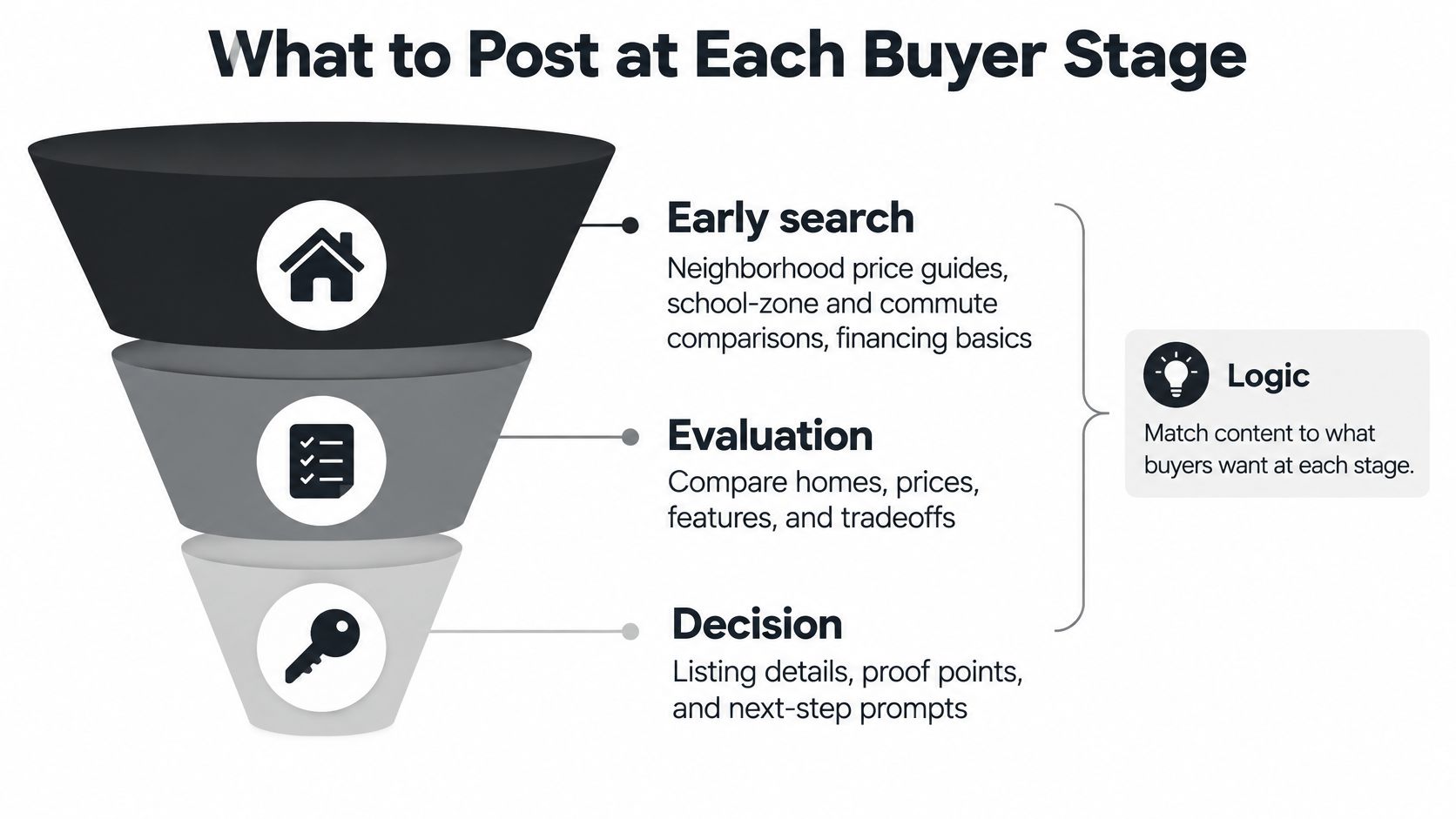
Match the explanation to the decision
Consider a hypothetical three-bedroom listing. An early-search post could identify its verified school zone, explain the layout, and link to current property details. School information should remain factual, with boundaries checked against the responsible authority rather than described through subjective neighborhood claims.
An evaluator needs something different. A proposed ten-minute inspection walkthrough could explain visible roof conditions, what an inspector assesses, and which questions require a specialist. It shouldn't present an agent's visual observations as an inspection report.
A buyer closer to acting may need an offer-process explainer. Explain who handles each task, what documents are involved, and where timing can change. A verified testimonial can support that explanation, but it shouldn't promise the same outcome for another buyer.
Preserve enough context to learn
Each post should carry internal metadata: market, property type, buyer stage, format, and call to action. A spreadsheet is sufficient if the labels remain consistent. The social media content strategy guide can help turn those labels into a repeatable editorial plan.
Format variety matters only when it serves the information. Teams looking to broaden their mix can grow your audience with Clepher's tips while keeping buyer intent, rather than novelty, as the selection rule.
After first contact, the content should support an existing conversation rather than restart the sales pitch. Lender questions, moving checklists, and relevant updates give prospects something useful to return to.
Track profile visits, saves, direct-message questions, website sessions, and viewing requests. These signals help distinguish content people briefly noticed from information they used while considering a property.
How to Build a Listing Post That Sells the Facts
A listing post should help a buyer decide whether a property deserves a closer look. Attractive footage matters, but missing costs, unclear dimensions, and unsupported neighborhood claims create avoidable follow-up work.
The strongest production habit is to build the factual record before editing the video. That prevents a polished draft from circulating with an old price or an unverified feature.
Build the post from a checked property record
- Pull the facts first. Collect price, beds and baths, square footage, lot size, HOA fees, property tax, and days on market from the current listing record and supporting documents. Record the source and verification date internally so another teammate can check the caption without repeating the research.
- Shoot a short, legible walkthrough. A useful production target is a 30-to-45-second vertical clip showing the front door, kitchen, a room in natural light, and a three-second wide shot that explains the layout. These are editing recommendations, not platform limits; the purpose is orientation, not a rapid montage that hides how rooms connect.
- Write a specific hook. For a hypothetical property, the lead could be three bedrooms under $450,000 with a fenced yard two blocks from the elementary school, provided every detail is verified before publication. A concrete statement gives buyers something to assess, while phrases such as dream home add little information.
- Keep the caption selective. Lead with the three most useful facts, add a relevant local detail, and finish with a viewing-request prompt. The destination should make the next action clear, such as selecting a preferred viewing window, rather than asking for an unspecified direct message.
The visual sequence below keeps the listing facts central.
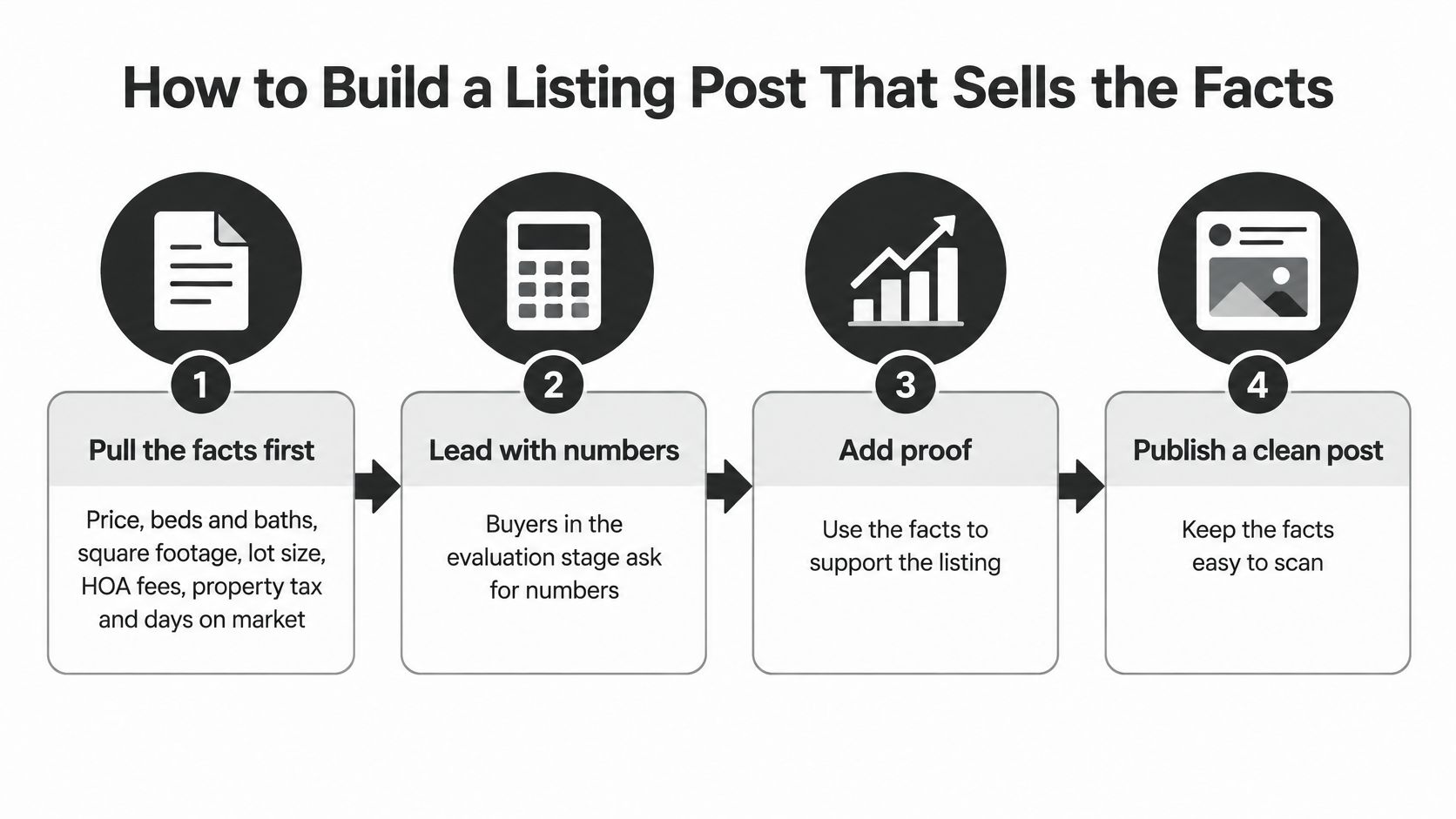
Adapt the presentation without changing the claims
- Prepare network-specific versions. A practical editing setup uses 9:16 footage for Instagram and TikTok and a 16:9 version for a standard YouTube walkthrough. LinkedIn can use a text-led explanation with a verified local market figure when available; copying the same caption everywhere wastes the different presentation options.
- Complete a factual and compliance review. Confirm the square-footage source, HOA amount, and applicable disclosures, then reconcile every claim with the MLS listing and disclosure file. Review Fair Housing rules and local advertising requirements, especially wording about neighborhoods, schools, and buyer types; avoid language that suggests who should or shouldn't live in the property.
- Assign the response work. Set an internal service target of replying to initial comments and questions within one business day. The publishing owner should know who can answer property questions and who handles viewing requests, so a scheduled post doesn't become an unattended inquiry channel.
A useful listing post makes the property easier to evaluate. It doesn't make the property appear different from its documented condition.
Reusable release checklist
- Facts checked: Price, measurements, costs, status, and disclosures match the current records.
- Media reviewed: Footage shows the layout accurately, and captions remain readable.
- Action tested: The viewing destination works and identifies the property.
- Owner assigned: Someone is responsible for replies and listing changes after publication.
Education Video Buyers Actually Search For
Buyers don't use video only to browse attractive homes. 66% of buyers used YouTube for homebuying education, rising to 74% among Gen Z, according to the audience findings discussed by BAM. Separately, the RE/MAX Future of Real Estate Report found that 41% of Gen Z and millennial consumers used social media to learn about real estate in 2024.
That makes educational video a different assignment from listing promotion. A buyer searching for an explanation needs an answer before an invitation to book.
The image below highlights the role of video in that information search.

Choose questions that need a local explanation
A manageable education library starts with these formats:
- Affordability walkthrough: Explain the cost categories a buyer needs to consider, without presenting an illustrative payment as a loan quote.
- Inspection explanation: Separate observed conditions, inspection findings, and specialist advice.
- Neighborhood comparison: Compare documented housing features, transport options, and amenities without steering buyers toward particular communities.
- Financing scenario: State assumptions clearly and have a qualified lending professional review sensitive details.
- Offer-process explainer: Explain documents, responsibilities, and possible decision points without promising acceptance or a fixed closing date.
Specific titles work better as an editorial discipline than broad topics. An explanation of what happens after an inspection gives the presenter a clear boundary. A general first-time buyer video can easily become a list of disconnected tips.
Record once, edit for distinct uses
A proposed weekly workflow starts with a source recording of about 15 to 20 minutes. The editor then extracts three roughly 60-second clips for YouTube Shorts, Instagram, and LinkedIn video, with a separate caption for each destination.
Each clip should answer a complete question. Add on-screen text and accurate captions so the explanation remains usable without sound. Review rates, prices, school references, and other market-sensitive statements immediately before publication.
The embedded video provides another viewing format alongside the production plan.
A team using this proposed schedule can cycle through the five formats over five weeks, then revisit them with updated local examples. It shouldn't recreate an entire production concept every time.
Measure educational usefulness beyond views. Track qualified consultations, repeat viewers where available, and assisted conversions recorded during intake. A narrowly relevant explanation can be worthwhile even when it doesn't attract a broad audience.
Run One Workflow Across Several Accounts
| Network | Limit or requirement | Check before queuing |
|---|---|---|
| Professional account and publishing permission; media container expires after 24 hours | Publish inside the window or recreate the container | |
| YouTube | 100-call-per-day quota for the upload bucket | Batch uploads and retry after the quota resets |
| 150 requests per member per day | Count calls per member and keep a safe margin | |
| Endpoint and account-specific limits require verification | Confirm in Meta's current documentation | |
| TikTok | Current upload and publishing limits require verification | Confirm in TikTok's developer documentation |
| X | Access-tier and endpoint limits require verification | Confirm the current API access tier |
The Instagram requirements, 24-hour container expiry, YouTube 100-call-per-day upload bucket, and LinkedIn 150 requests per member per day are listed in the social media API posting-limits summary. That summary also contains conflicting Instagram daily-post figures, so implementation decisions should use each network's current official documentation.
These are API constraints, not recommended posting frequencies. An upload call isn't necessarily a published post, and a scheduler's calendar doesn't prove that an account remains authorized.
Separate editorial preparation from publication
The publishing sequence should make failures visible before a property campaign depends on them.
- Create the master record. Store approved property facts, original media, disclosure notes, and the destination page together. Keep client accounts and property campaigns clearly separated.
- Prepare each network's asset. Adapt length, crop, caption, thumbnail, and accessibility text before placing the post in the publishing queue. A shared factual source should not mean an identical finished asset.
- Validate the account and media. Check permissions, account type, token status, and whether the uploaded media is ready. For Instagram, avoid treating a media container as permanent storage.
- Schedule deliberately. Place approved posts on a calendar and distribute them across the week instead of publishing an entire batch at once. Assign a person to monitor the posts when they go live.
- Handle failures explicitly. Log the account, network, error response, asset, and attempted publication time. Retry once when the failure is transient and retrying is safe, then route unresolved errors for manual review rather than creating an endless loop.
- Recycle selectively. Neighborhood guides and process explanations can return on a planned schedule. Recheck their facts first, and exclude expired listings or outdated financing examples.
Evaluate the tool by its failure handling
FoPost supports writing once, adapting for each network, scheduling, publishing, and measuring results across 33 networks from a single workspace. Cross-Posting publishes to 33 platforms at once, while its API and SDKs support developer-built publishing workflows; each workspace also provides reach, engagement, and follower-change analytics for every account.
The cross-posting workflow is useful when account switching and repeated preparation consume production time. It doesn't remove the need for property review or network-specific validation.
Other schedulers can also suit this work. The fair comparison is whether the implementation checks relevant limits before queuing, identifies failed posts clearly, and preserves enough information to recover without accidentally publishing duplicates.
Track Qualified Leads and Pick Two Networks for 30 Days
39% of respondents selected social media as a technology producing the highest number of quality leads during the previous year, compared with 23% for CRM systems and 17% for local MLS systems, in the NAR 2025 Technology Survey. Yet a real estate marketing summary citing NAR buyer research reported that only 3% of buyers first contacted an agent through social media, versus 43% through referrals, while 41% of prospective buyers were more likely to hire an agent with a social presence because it helped them feel familiar with and trust that person.
Those findings measure different things. The technology survey describes NAR members' assessment of lead sources, not every property business. First contact measures how a buyer initially reached an agent, not every influence on that choice.
A referral can introduce an agent while social content helps the buyer assess that agent afterward. Direct acquisition and trust-assisted conversion belong in separate reporting fields.
The decision panel below turns that distinction into a limited test.
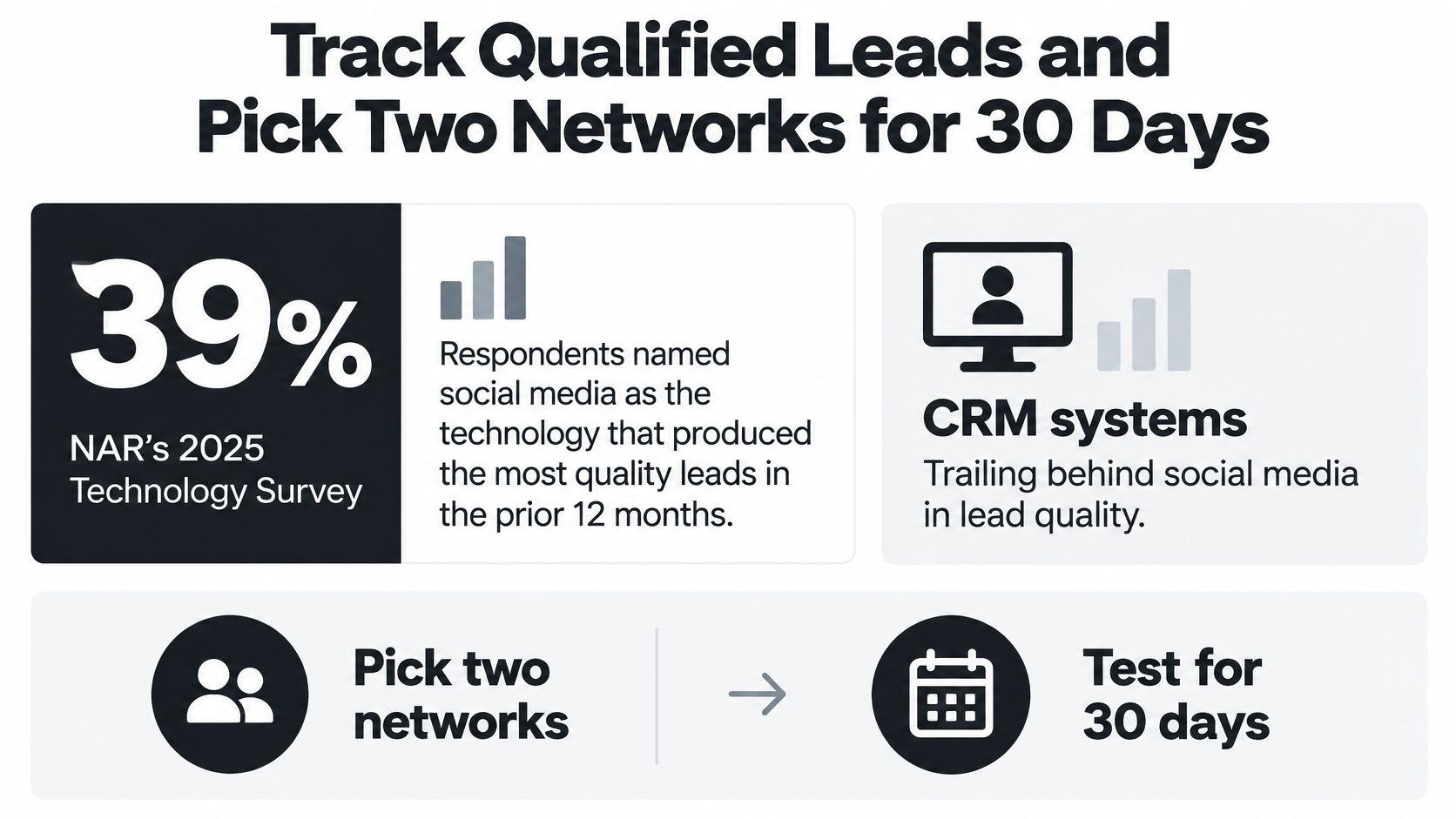
Set the test before publishing
A practical experiment is to choose two networks for 30 days. One should match where existing clients spend time. The other should match content the team can realistically produce every week.
That creates a capacity decision as well as a marketing test. A channel that requires constant rescue work may not be sustainable, even if an occasional post performs well.
Attribution rule: Record how the buyer arrived and what helped the buyer decide. Don't force both answers into a single source field.
Use a consistent tracking method:
- Label each post. Give it a campaign name and originating platform. Keep those labels consistent in publishing records and destination links.
- Separate contact paths. Assign each network a contact label or landing page. Use campaign parameters without placing personal information in URLs.
- Define qualification. For this test, count inquiries that become a viewing or consultation as qualified leads. Keep raw messages separate so spam, supplier pitches, and casual reactions don't inflate results.
- Review supporting metrics. Reach, engagement, and follower change help explain distribution, but they aren't client outcomes. A consistent social media engagement-rate calculation makes comparisons more useful than switching definitions between reports.
- Make the decision at day 30. Retain networks producing qualified inquiries or consultations. Reformat weak content before abandoning a potentially suitable channel, and drop activity that consumes time without a credible next step.
Keep the interpretation honest
A small test can reveal operational problems and promising topics without proving a permanent winner. A listing may appeal to an unusually narrow audience, or a consultation may happen after the reporting window. Keep open opportunities visible rather than treating them as either closed revenue or failure.
Intake should include a neutral question about what helped the prospect choose the agent. If the answer includes a neighborhood video or inspection explanation, record that as an assisted influence without overwriting the original referral source.
Track production effort alongside outcomes. An education clip that supports useful consultations may deserve continued investment even when its view count looks modest. A heavily edited property tour with broad reach but no relevant inquiries may need a different topic or call to action.
This week's practical assignment is to select the two networks, prepare three factual listing posts and an education clip, and add a source field to the contact list. Assign responsibility for logging consultations before the first post goes live.
FoPost offers a shared workspace for adapting, scheduling, and publishing real estate content across multiple networks. Visit FoPost to organize the initial test, then pair account analytics with viewing and consultation records to judge what deserves continued effort.