Facebook counted 3.07 billion monthly active users in 2025, according to Hootsuite's 2026 social media statistics report. Pew Research Center's survey of 5,022 U.S. adults, fielded from February 5 to June 18, 2025, found 71% of U.S. adults use the platform. The audience isn't the constraint. Attention is.
That's why most answers to how to increase FB followers miss the mechanism. Follower count is an output, and it comes from two stages that fail for different reasons: a post reaching people who don't follow the Page yet, and a first-time visitor deciding the Page deserves a follow. Measure those stages separately and the repairs get obvious. Blur them together and every problem looks like a content problem.
The sequence below fixes the Page first, then measures the right four rates, then builds a discovery habit, then runs a dated test to find formats that convert.
Table of Contents
- Check Your Page Against Realistic Benchmarks
- How to Set Up Your Page to Earn Follows
- Track the Four Rates That Predict Follows
- Earn Follows From People Who Do Not Follow Yet
- Run an 8-Week Format Test With a Dated Plan
Check Your Page Against Realistic Benchmarks
A healthy Page is judged against its own reach and engagement, not against a follower tally. The follower number records how many people opted in at some point. It says nothing about whether your next post reaches anyone.
DataReportal's February 2025 Facebook analysis puts average engagement at about 0.15% for Facebook Page posts when the figure is calculated against Page followers, and the rate moves with audience size: roughly 0.30% for Pages under 10,000 followers, 0.15% for Pages with 10,000 to 100,000 followers, and 0.08% above 100,000. Measured against actual post reach rather than followers, average engagement in the same analysis sits below 2%, and the trend across the preceding year was negative. Two framings answer two questions. Engagement per follower tests whether the audience is awake. Engagement per reach tests whether the content travels.
Baseline, not promise: a benchmark describes the middle of a very large sample. The only figure worth optimizing against is your own Page's four-week median.
Then there's the size question, which most guides get wrong. A 2024 study published in PNAS Nexus analyzed approximately 57 million Facebook posts from more than 1,000 European news outlets across four languages, covering 2008 through the end of 2022. The researchers found the likelihood of producing viral content was independent of an outlet's follower size, with smaller Pages generating widespread attention at rates comparable to much larger ones. On daily and weekly time scales, engagement and page size followed a broadly universal pattern.
The same study carries a warning. Source reliability shaped long-term engagement, and unreliable sources lost engagement over time. Sensational posting buys a spike and taxes the trend.
Three checks to run today
- Engagement per reach across your last 10 posts. Add reactions, comments and shares, divide by reach. Most Pages have never looked at this number and guess wrong about it.
- Compare it with the sub-2% figure and with your own four-week median. If you're under 10,000 followers, compare engagement per follower with the 0.30% band too. Two numbers, two verdicts.
- Name the gap. Low engagement per reach is a content problem. Healthy engagement per reach with few new follows is a conversion problem, and no amount of extra posting fixes it.
When you eventually put budget behind a post, paid performance becomes its own measurement question, and it helps to know what a normal click-through rate looks like before you blame the creative. Facebook ads CTR benchmarks compared from Rapid Ads gives you that reference range so a weak offer doesn't get mistaken for weak targeting.
How to Set Up Your Page to Earn Follows
A follow decision takes seconds. Someone arrives from a post, a share or a search result, scans the top of the screen and decides. Discovery brought the visit; the Page itself has to convert it. Every fix below takes minutes.
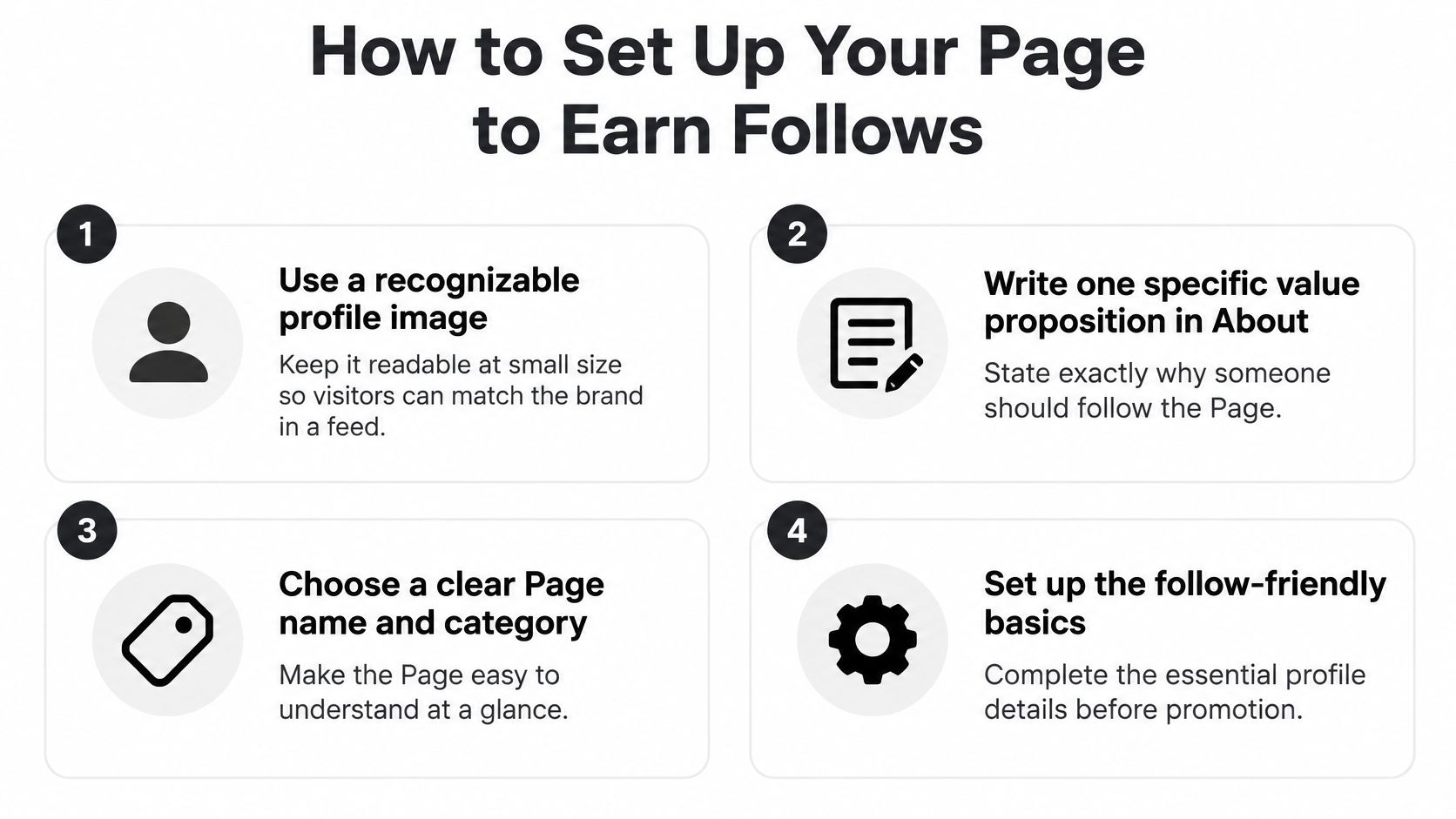
- Choose a profile image that survives a thumbnail. A face or a single clean mark stays legible at small sizes, while a three-line wordmark turns to mush. Check it on a phone at feed size before committing.
- Write one value proposition in About. Name who the Page is for and what they get, in one sentence. "Weekly teardowns of paid social campaigns for DTC brands" tells a visitor whether to follow. "Passionate about marketing" tells them nothing.
- Complete the contact block. Phone number, hours, and a website link that resolves. A dead link reads as an abandoned Page, and an abandoned Page doesn't earn follows.
- Pin an introductory post. Cover the topic, state the posting schedule and give one concrete reason to follow, such as a Thursday breakdown of a real campaign. The pinned post does the selling so individual posts don't have to.
- Turn on Page Recommendations. Meta's Page Recommendations guidance explains that recommendations give customers a way to submit a rating, and that they can raise visitor trust and help the Page surface in searches for specific terms. Ask satisfied customers for honest feedback after a completed purchase, and never trade a discount for a rating.
- Hold off on heavy Insights reading until the Page has a real audience. Audience interests, ages, action-button clicks and post engagement only become useful once enough followers and visitors have generated data worth reading. Before that, judge setup changes by profile visits and follows on the pinned post.
Two mistakes show up more than any others. The first is a value proposition written for the owner rather than the visitor. The second is asking for a follow without saying what following delivers.
Give the Page a stranger test. Open it on a phone in a private browser, with no history and no context, and count the seconds until the reason to follow is visible.
Five is generous. If the answer takes longer, rewrite the About line and the pinned post before touching anything else.
Track the Four Rates That Predict Follows
A follow is the last step in a chain. A post reaches someone, some of those people react, some visit the Page, and a fraction decide the next post is worth seeing. Four weekly rates show which link in that chain is breaking.
| Rate | Formula | What a weak reading suggests |
|---|---|---|
| Engagement rate | Engagements divided by reach | Content prompts reactions but not a next action |
| Follow conversion from reach | New follows divided by unique reach | The format is not attracting the right audience |
| Unfollow rate | Unfollows divided by followers at the start of the week | Growth is low-intent or the topic has drifted |
| Net follower growth | New follows minus unfollows | The overall trend is off, so check the other three rates |
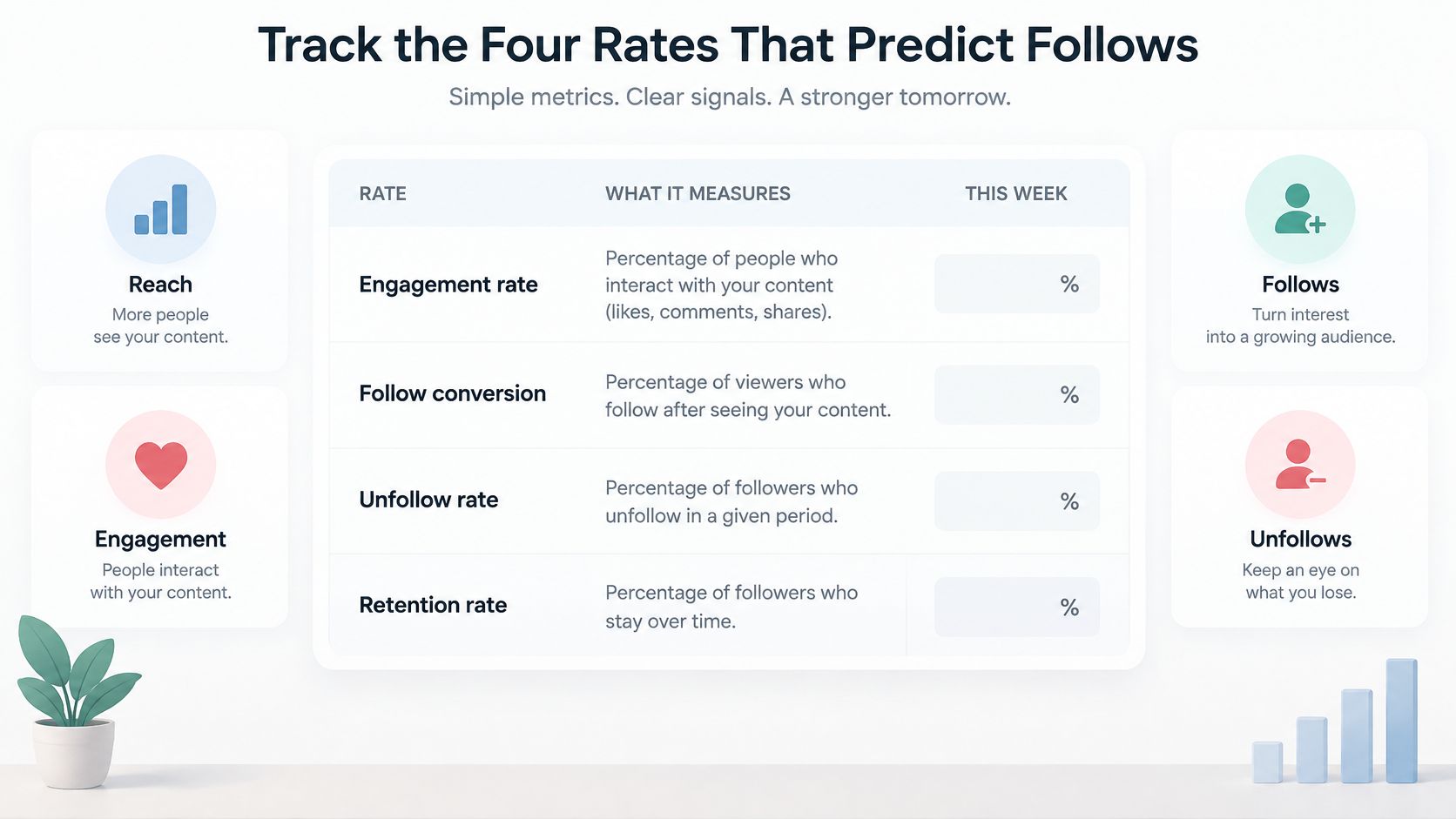
The arithmetic only holds if the inputs are clean, and the Meta Graph API insights reference is where to check definitions: post engagements cover reactions, comments, shares and related actions, while follower metrics split into daily unique follows, unfollows and net lifetime follows. A single combined engagement figure hides the unfollows, and unfollows are the part that reveals whether the right people arrived.
Read the rates in a fixed order every week: engagement rate, follow conversion, unfollow rate, net growth. Each reading narrows the suspect list. Jumping straight to net growth turns a diagnosis into a mood.
The warning sign to watch for: a rising engagement rate with flat net follower growth. Comments and reach can come from people who will never return.
That combination is common and expensive. A post that collects argumentative comments from outside your audience lifts engagement and adds zero followers, and the following week's unfollows record the damage. Judge a post by the follows it produces. A busy thread proves attention, and attention from the wrong crowd converts to nothing.
External benchmarks work as guardrails here. Published averages of organic reach agree on one point: the share of followers a post reaches depends heavily on audience size and on how the sample was drawn, so any single average is a weak yardstick for a particular Page. If reach looks healthy for a Page your size and follows stay flat, the content is being seen and failing to convince, which calls for a different repair than a reach problem.
Test one variable at a time
Change the hook, the creative, the call to action or the posting time, one element per cycle, and hold the rest of the campaign fixed during the test window. Keep paid follows and organic follows in separate columns, because Meta reports those sources independently and blending them produces a figure nobody can act on. Then put promotion behind posts that already convert well. A post that performed with existing followers can still convert poorly with strangers, and only the second number predicts growth.
Twenty minutes a week is enough for the review: one chart with the four rates, one decision about next week's formats. If the arithmetic still feels slippery, how to calculate social media engagement rate walks through the formulas step by step. And when weekly numbers wobble, a repeatable framework for analyzing brand content keeps you comparing the same measure across the same window instead of switching metrics every time the trend dips.
Earn Follows From People Who Do Not Follow Yet
The standard first move in most Facebook growth guides is inviting friends and email contacts to follow the Page. That worked when the Feed ran on connections. It's now the least scalable option on the list, because a large share of what people see comes from recommendations rather than from Pages they chose.
Shno's roundup of Facebook marketing statistics reports that nearly one-third of Feed content consists of unconnected recommendations, and cites a 2025 Meta change that increased same-day Reels recommendations by 50%. Discovery is a channel with its own rules, not a side effect of having followers.
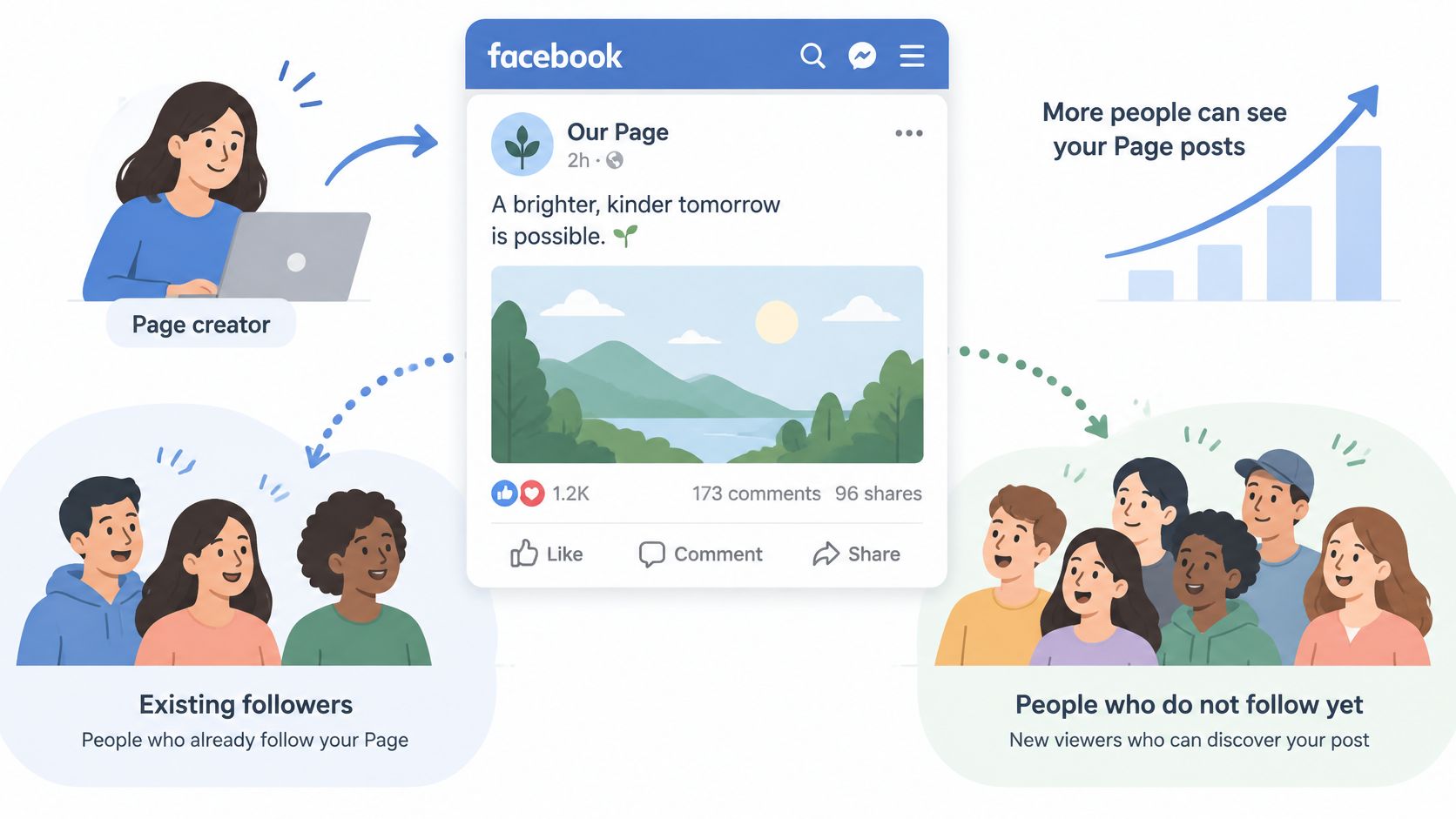
Meta's description of how suggested Feed content works says suggestions draw primarily on a person's previous engagement and can include photos, videos and articles. Meta also says it looks for Pages that have been active for a sufficiently long period and have a sufficiently large follower base, because that history helps it predict whether people will find the content relevant. Neither condition can be faked in a week. Both reward sustained, focused publishing.
Eligibility isn't automatic. Meta states that content must comply with its Publisher and Creator Guidelines and other recommendation rules, and Meta's guidance on original content adds that material posted without substantial changes counts as unoriginal and receives reduced distribution. A reposted clip with a caption doesn't qualify. The same clip with your own commentary, a new storyline or original analysis can.
Five steps that work with recommendations rather than against them
- Write an opening that earns reading time. The first line decides whether the rest gets read, and reading time is one of the signals in play.
- Make every video understandable without a long setup. Someone who has never heard of the Page is watching, and a thirty-second preamble loses them.
- Cover one clear topic per post. Topic focus is what lets the system match a post to people who care about that topic.
- Adapt each network's version instead of duplicating one asset. The hook, length and follow prompt that suit a Feed recommendation aren't the ones that suit other networks. Longer ideas often need to become short-form videos before they belong in a Reels feed.
- Judge each post by non-follower reach and follower conversion. Follower count describes yesterday. Those two numbers describe what the next post will do.
Building the raw material for that mix is a separate craft, and Netco Design's social media content guide covers the format choices, from carousels to short video, that give you something worth adapting for each network.
Run an 8-Week Format Test With a Dated Plan
Format guessing is where most follower plans die. The fix is a dated experiment with a fixed set of variables, run long enough to produce a comparison and short enough that nobody loses interest.
Week 1
Finish the six setup items, publish the pinned introductory post, and switch on Page Recommendations. Nothing gets tested this week. The point is to remove setup as a variable, so later differences in follows come from content rather than from a half-finished Page.
Weeks 2 to 8
Publish 3 to 5 original posts per week across at least three formats: short native video or Reels, image or text posts, and a small number of links. Fix the posting days in advance rather than deciding each morning. Tag every post by format and by campaign so the data can be sorted later.
Keep the offer and the audience constant for the whole test. If week three promotes a new product and week five promotes an old one, you've measured the products, not the formats. If three formats feel arbitrary, building a social media content strategy around two recurring series plus one experimental slot keeps the calendar honest.
The timeline below is the method in one view.
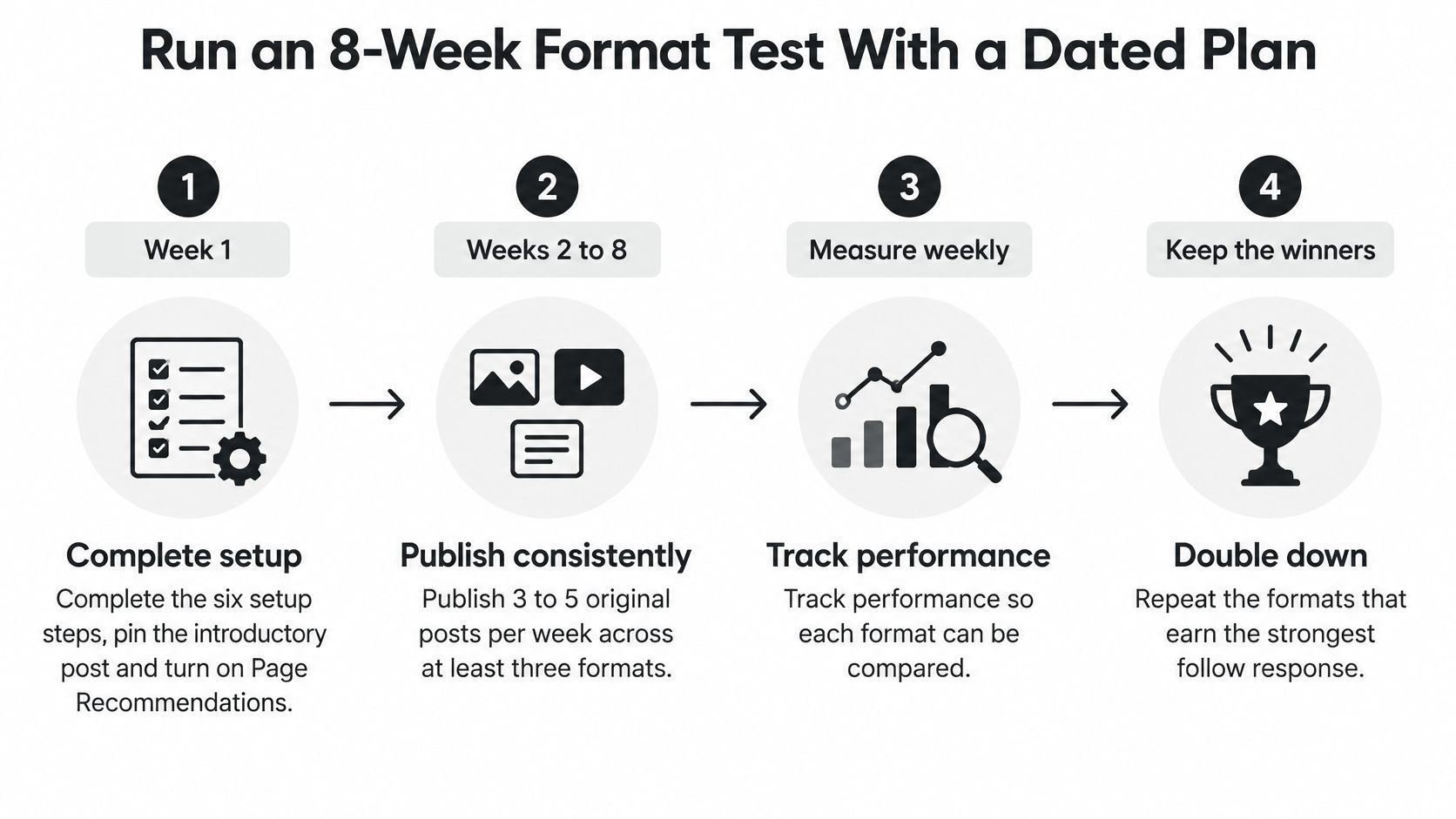
For each format, log reach, meaningful engagements, profile visits, follows and unfollows. Then compare the formats on the follow conversion rate already in your weekly sheet, because that number measures whether non-follower discovery is turning into follows or stopping at reactions.
What volume actually looks like across brand Pages
A 2025 benchmark analysis of 24.96 million posts from 139,000 Facebook brand Pages found that brands averaged 39 posts per month, and that the mix shifted rather than expanding. Link posts fell from 19 to 10 per month, while Reels rose from 5 to 7.
| Post type | Earlier period | 2025 average per month |
|---|---|---|
| Link posts | 19 | 10 |
| Reels | 5 | 7 |
Those figures describe large brands, and the mix shift is the interesting part: less outbound linking, more native video. For a small Page, volume without value performs worse than modest volume. Pages publishing at very high frequencies tend to earn fewer clicks per post than Pages on a lighter schedule, so more posts do not equal more follows. Past a point, each post earns less attention.
Set the ceiling before the calendar: if the team can't produce four good posts a week, the plan is three, not ten mediocre ones.
Measure the signals the system predicts, not just reactions
Meta's description of its ranking signals lists the likelihood that someone will comment, spend time reading, watch a video through completion, click, like, share, or find a post informative. It also evaluates whether a post looks like clickbait. That's a usable scorecard for the test: track completion on video, comments and shares on text, and treat engagement bait as a failure even when it produces numbers, because the system evaluates it directly.
The 28-day decision
At the end of each 28-day cycle, keep the formats whose follow conversion beats the Page median and discontinue the ones that earn reactions without follows. A format that produces likes and no follows is a branding exercise. Keeping one is fine, deliberately, with the cost understood.
Two formats sometimes tie on conversion while differing on non-follower reach. Keep both and weight the one that introduces the Page to more new people, since conversion only matters once discovery has already happened.
FoPost holds the posting days fixed and generates the per-network variants from a single draft, which removes the most common reason a dated test slips: someone runs out of time on a Tuesday and posts whatever is closest.
Finish this today
Write the pinned introductory post. One sentence on who the Page is for, one on what gets published, one on when, and one reason to follow. Publish it, pin it, and the eight-week plan has its starting point.
FoPost handles the mechanical side of this plan: connect the Facebook Page alongside your other accounts, write once, generate a version for each network, schedule it, and read followers, reach and profile activity per account in one place. The workflow runs in three steps, Connect, Write and Publish, which keeps a dated test on schedule when the week gets busy. Start with the pinned post today at FoPost.